
Leveling Up Your Debate Software 3: Curing Stylepox
Fixing an age-old pet peeve.
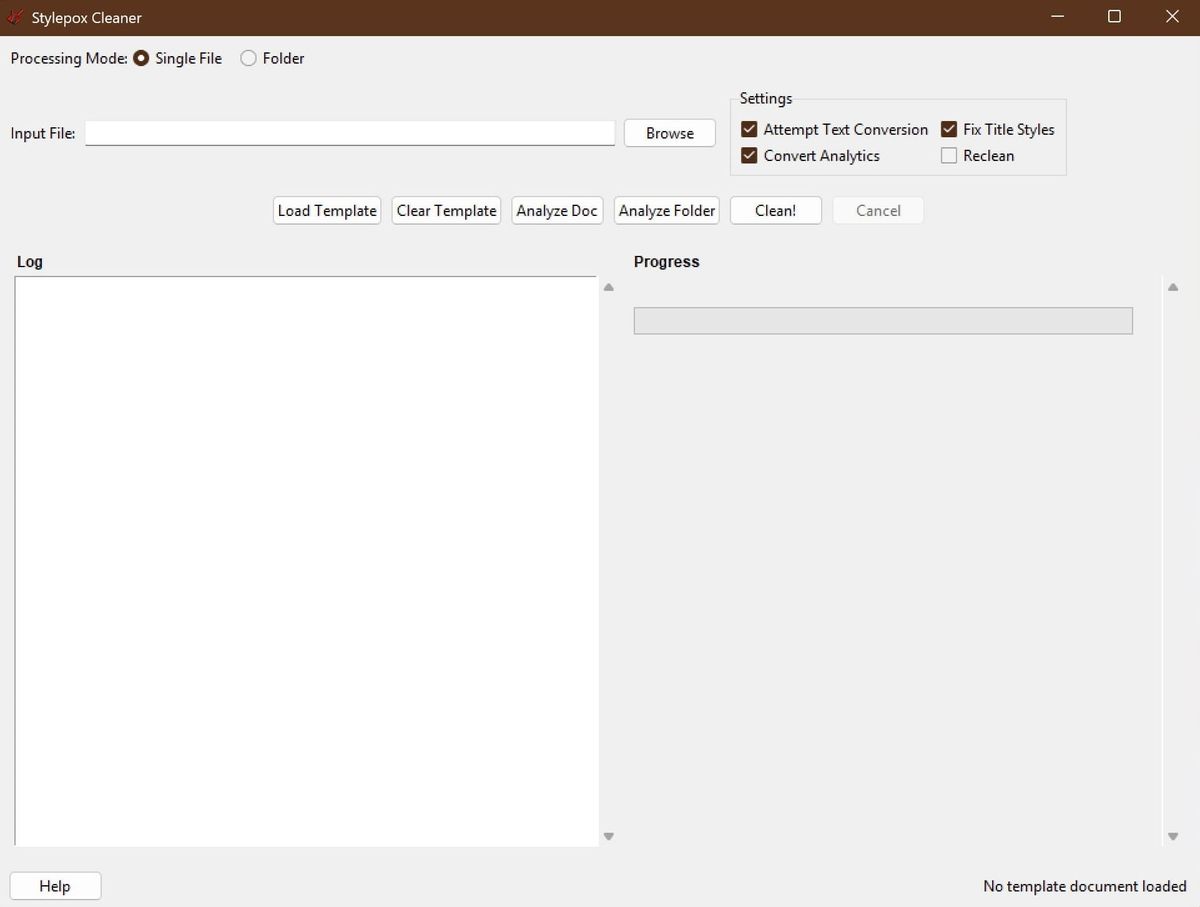
This is stylepox:
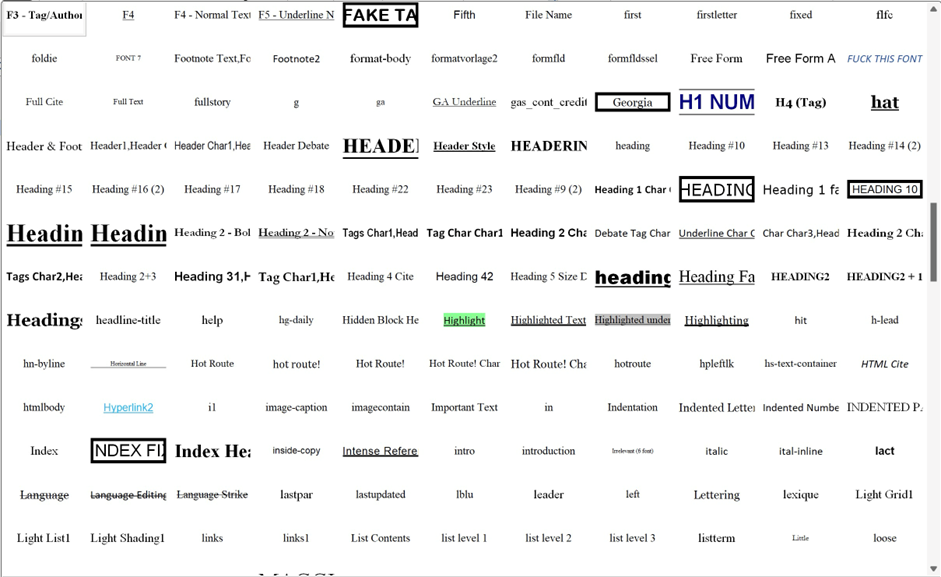
So is this:
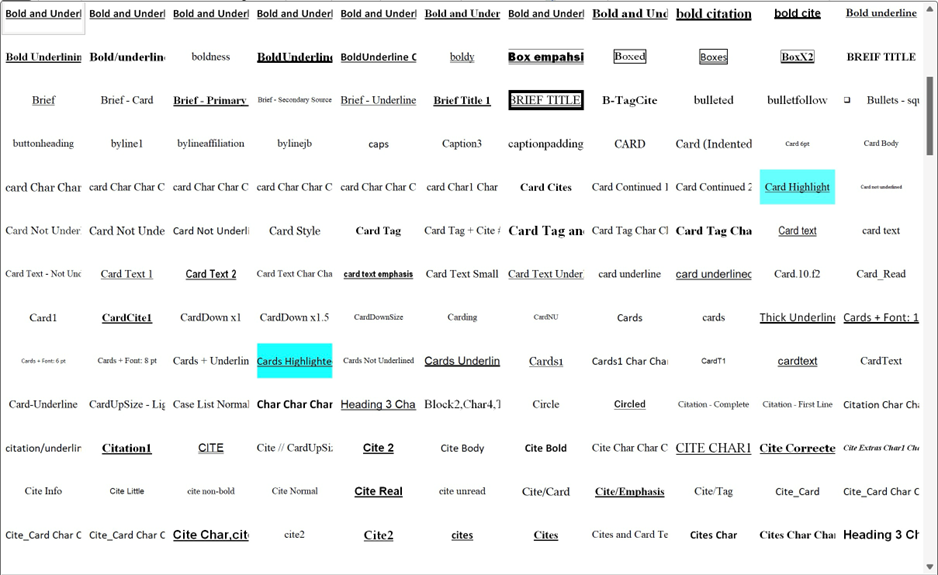
These screenshots show the "styles" menu in Microsoft Word on documents infected with what I'm calling Stylepox: a data bomb consisting of thousands of garbage styles that has infected the majority of speech documents circulating in debate.
Stylepox spreads through copy-paste. When you copy text from a Word document, any custom styles in that document hitch a ride into yours. Copy from enough sources and your file accumulates hundreds of styles you never asked for, slowing Word to a crawl and bloating your file by the size of a small DA. Some styles are particularly malignant and sneakily overwrite Verbatim styles, breaking the functionality of Verbatim macros that work based on style name. As cards are copied over and over again, the style avalanche grows, picking up various detritus until it reaches Word’s hard cap for styles in a document at 4,085.
In short: if your document formatting is malfunctioning for reasons you don't understand, there is a reasonable chance Stylepox is the cause.
There are 3,558 open source documents on this year’s college wiki so far. Of these, 62.36% – or 2,219 – are infected with Stylepox. That’s 222 entire aff files’ worth of data storage on the wiki devoted to JUST styles. This year's high school wiki adds another 460 aff files. Last year's adds another 730 aff files.
What is this precious data we are storing thousands of copies of on our computers? Glad you asked. Each infected document on your computer contains extremely detailed formatting information for the most lovingly crafted styles you ever did see:
- The alluring “Hot Route”, “hot route!”, “Hot Route!”, and “hotroute” (an easy one to understand – once you make your first Hot Route who wouldn’t get carried away and make three more)
- The classic “Omnipage” #1 through #71
- The ironically unbolded “boldness” and “boldy” or the uncapitalized “caps”
- The self-reports, both social – such as “Offensive Language” (presumably for the searching convenience of any K team hunting for links in an aff speech doc) or “Swag” (come on) or "FUCK THIS FONT" (they say behind every window is a story and I will admit to being curious about what this person was going through) – and technical – revealing a mysterious category of person who knows about custom styles but doesn’t know about font sizes and so chose to shrink non-underlined text with the custom styles “Small,” “Really Small,” and “Really Fucking Small.”
Why not just remove the styles directly? Easier said than done. First, many of the styles are intertwined with the structure of the document in convoluted ways, so removing undesired styles wrecks critical formatting in the document that would be very annoying to restore by hand. Second, styles are not the only problem: there is also a broader issue of people using Verbatim incorrectly, such as by directly bolding and underlining text instead of using the built-in Verbatim functions, that I was also hoping to fix.
Is this the biggest problem in the world? No. But Stylepox has been my white whale for like five years and I am pleased to report that I finally have a solution.
The Solution
The solution is Stylepox Cleaner, which I have added to my Dropbox folder of debate software.
Point it at a file (or an entire folder) and it will:
- Purge unapproved styles. The cleaner keeps only the styles Verbatim actually needs – your Headings, your Cite, your Underline, your Emphasis – and nukes everything else. Goodbye, Omnipage #47. So long, Really Fucking Small.
- Fix direct formatting. Remember how I said styles weren't the only problem? If someone manually bolded their tags instead of using Verbatim's Cite style, the cleaner detects that and converts it. Same with underlining, highlighting, and boxing. The goal is a document where all formatting comes from styles, not from someone mashing Ctrl+B in 2004 – this way anyone with Verbatim who opens your document will see the exact formatting they like, allowing you to make the best possible impression.
- Restore Verbatim aliases. Even if a previous infection renamed "Heading 4" to something unrecognizable, the cleaner restores the proper names and aliases so your macros work again.
- Remove the cruft. Hyperlinks, explicit font declarations, paragraph spacing overrides – all the invisible garbage that accumulates in a well-traveled document gets swept out.
The result is a file that opens faster, plays nice with Verbatim, and won't spread disease to the next person who grabs impact defense from your speech document.
My recommendation would be that if you open a bunch of documents from the wiki to steal cards from them, you run the style cleaner on them first. This ensures any cards that make it to your own files are clean without you having to remove bad styles by hand.
A few notes:
- The cleaner saves a new copy with "_cleaned" appended to the filename, so your original stays intact.
- If you have custom styles you actually want to keep (maybe you've built a whole system around "Hot Route"), you can load a template document that contains those styles and the cleaner will preserve any styles it finds there.
- Folder mode processes everything recursively, so you can point it at your entire Dropbox and go make coffee (but be aware that the program can be quite slow depending on the severity of the infection – if you are batch processing a large folder you may have to leave it overnight).
- This program is compatible by default with my Advanced Verbatim template, so you do not need to attach a template document to preserve the Analytic and Undertag styles.
Disclaimer: this is still not going to be perfect. I have played whack-a-mole with literally dozens of edge cases but I’m sure there are more. Please check to make sure cards were reformatted correctly in the cleaned copy before getting rid of the original version.
An Offer and a Request
Offer: If you have some formatting gimmick that you would like to preserve but don't know how to do that without breaking Verbatim, please feel free to reach out and I will be happy to help how I can.
Request: I was kind of curious to see who patient zero was and wanted to see if open source documents could reveal the answer. Unfortunately OpenCaselist’s very useful bulk downloads feature only goes back the last couple of years, and I am not dedicated enough to download the documents I’d need by hand. If someone is aware of a really old file that has maxed out styles I would love to hear about it. You can identify it easily by opening it and looking at the style pane or using my program's built-in document/folder analysis tools.