
Wake '25 Takes
The first semester comes to a close.
Tournament Recap
Kansas LS wins! They defeated Emory GS for their first major tournament win. Two semifinals and a quarterfinals previously. Emory GS has one tournament win, one finals and two semifinals.
Michigan BP has two tournament wins, a finals and a semifinals.
A fluid Copeland race with two tournaments and a round robin to go.
By my count 50 teams have cleared at one of the four major tournaments thus far. Teams joining the ranks at the Shirley were Georgetown GT, Northwestern LL and UTD DD. Congrats on clearing!
Three upsets in the doubles – Iowa EW (23) over Texas (10), Michigan ES (18) over Kentucky RW (15) and Emory LY (21) over Kansas SS (12).
The octafinals had fireworks - Emory LY (21) upset Georgetown AC (5) and MSU GL (13) upset CSU Long Beach MO (4)
Emory LY as the 21st seed is the lowest seed to advance to the quarterfinals of a major this year. A Cinderella run!
Kansas LS (3) defeated Michigan BP (2) and Emory GS (1) to secure the tournament victory.
The Affirmative won:
- 7 of 16 doubles debates (44%)
- 3 of 6 octafinals debates (50%, two walkovers)
- 2 of 4 quarterfinals debates (50%)
- 1 of 2 semifinals debates (50%)
- 0 of 1 finals debate
That is 13 of 29 for the affirmative in elimination debates (45%).
In the tournament as a whole, the neg won 264 of 509 debates (51.9%), which has a 21.3% chance to happen with a fair coin.
Cumulatively across the NU Season Opener, Kentucky RR, Kentucky, Gonzaga, and Wake tournaments, the neg has won 933 of 1756 debates (53.1%), which has a 0.5% chance to happen with a fair coin.
The ‘affirmative side bias’ continues.
The negative has won 3 finals. The affirmative won the Northwestern tournament on secondary strikes are topical.
The Wiki and Debate Docs
Doing this again and every time, but mainly because last time I gave shoutouts and slops. That was not right. It is supposed to be ‘props’ or ‘slops’ (get it?).
Props, as always, to the legends and heroes that use debate docs so people can save time and follow along with debates.
Standard issue slops to those that do not update their wiki during tournaments.
Slops to those that have bad wikis.
Slops to the edgelords who do not use debate docs.
A new specific one – slops to those that say they put debatedocs on their threads and it turned out to be debatedocs@UMICH.EDU. BOOO! Big Michigan hoses everyone again! Get a new name posers!
For the record it is: debatedocs@googlegroups.com
 Anthony Trufanov
They Are Multiplying
Harris’s? Harrises? Harrisi?
Scott and Ethan Harris judged at the Shirley this weekend. Can anyone name any other parent/child judging duos? Is there another Harris so we can have a panel?
1As
Do they ever help with creating the judge doc? Or are they afraid they would combust? I know there is a structural disadvantage to beating the negative on the judge, but does anyone try? Who is the fastest affirmative team on producing the judge doc?
Schedule Corner
Welcome back to Schedule Corner, the segment of the show where I complain in the most loving of ways about how tournaments are executed. This installment is a doozy.
First, release round 1 and 2 together and trim down the prep time. This is particularly true if you are trying to do lunch after round 2.
Second, shorten the breaks between debates substantially. I think there were 30 minute chunks of time between decision time and the next pairing. I would reduce that to 15 minutes. Tournaments should not be pedal to the metal, but this one swung too far in the other direction. There was infinite shoot the shit time. This schedule undervalued being done and sleeping. Round 1 to 2 and Round 5 to 6 were egregious on this front, but also too much time for meals. We are far removed from a high school situation where kids wanted to eat something and did not have the time to do so because the schedule is behind or the buildings are too spread out or whatever. College kids who want to eat do so and do it in a timely manner. A chunk cannot or will not eat tournament provided meals for various reasons, but adding more meal time does not help with that.
Third, do 8 prelim debates. We have to go back to this being standard practice. Leave the screwing 5-2 teams to the Glenbrooks. There were only two tournaments in the first semester that let teams put together a breakout prelim performance of 6-2 or better. Tragic!
I spoke with JGreen and the schedule does reflect deliberate thought and care; they are not doing things haphazardly. This does not mean that they prioritized the correct goals in my opinion. A stated reason for liking 7 and doubles was it helped get the campus in order before midnight (doubles uses less rooms than a prelim). Tightening the schedule would help mitigate the late nights. I am a fan of socializing the cost of additional cleaning help through entry fee adjustments.
Born Ready
Truf, judging round 1 of novice, at 7:58AM: “Are we going to be ready to start by 8 AM?”
GMU debater pops up and says: “They don’t call me Born Ready Sanchez for nothing.”
What a gem, Born Ready Sanchez (BRS) won a lot of fans this weekend. Some are saying he is going to be the next big thing. In fact, Truf had glowing reviews about each of the participants in that debate. The negative team from Texas was no slouch either, reaching the semifinals of the division. Kudos all around!
When a debater needed to go to the restroom BRS sagely said “when nature calls you never want to let her ring.”
Wise words, Born Ready Sanchez, wise words.
Tabroom Gripe
Emory SG?? That’s HODAZ. Horrible. Offensive. Dated. Ass. Zero.
Tabroom should force team initials to be alphabetical.
AM Radio for Every Vehicle Act
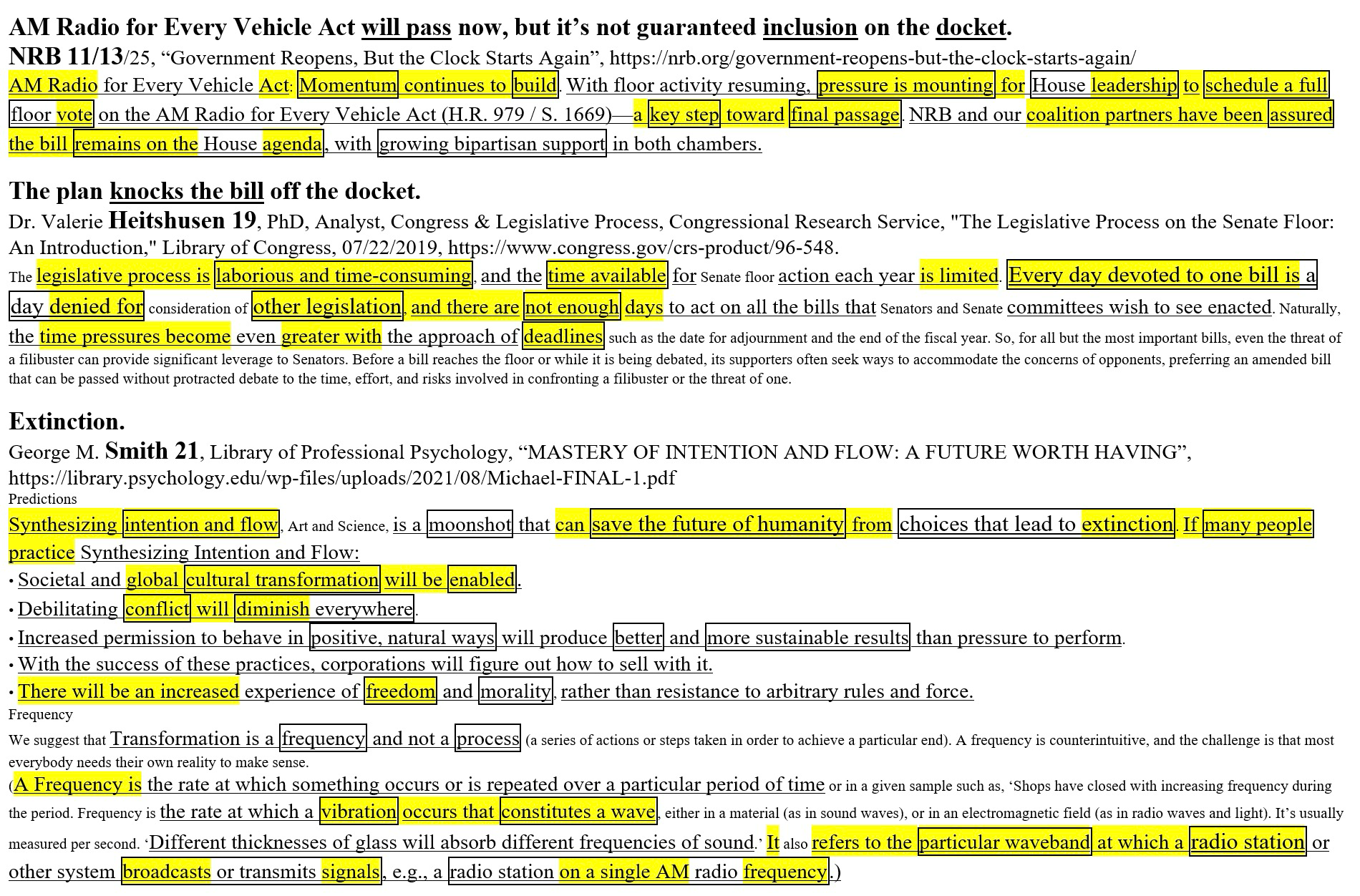
If you saw this DA and got angry that someone would have the gall to read something so silly, you are telling on yourself. The first goal this is trying to achieve is to conceal information (what the real politics DA in a real debate is going to be). The second thing it is doing is a competency test that operates on two axes:
One, will the affirmative figure out how to get a positive time tradeoff or will it suck time? If you do not actively time and monitor the 1NC when you are affirmative you may end up dropping a K (too soon?) OR you will not know how to balance your time in the 2AC. You have to know how long it takes to read this thing and then divide by 2 and that will be your response time.
The other axis is, will the affirmative be rage baited into cross-x’ing about this? The ideal number of questions the affirmative should ask about a position like this needs to be 0 or 1. If you ask more than 1, you have sprung the trap. If you opt to ask one, it has to be a pretty good zinger. Execute this at your peril!
NHP
Back in the fall of 2020 I introduced the idea of NHP, No Hassle Presumption:
 Lincoln Garrett
I said then:
“This one has been under development in the lab for quite some time. NHP is No Hassle Presumption. It is the idea that the negative can win with a CP even if it doesn’t have a net benefit if it proves to be less hassle than the plan.”
Fast forward to this tournament. Round 4. Georgetown AC vs Kansas LS. Georgetown reads the following plan:
“The United States Federal Government should render automation a mandatory subject of collective bargaining.”
The idea being that capitalist AI is bad, socialist AI is good.
Kansas goes on to win on the cap K in part because they won you don’t need to jump through all those extra hoops of federal labor law and collective bargaining negotiations to get to socialist AI.
No Hassle Presumption! Not wrong, just early.
Spirit of the Shirley
Spirit of the Shirley I am sure can mean different things to different people. Was the Spirit of Shirley the friends we made along the way? Who can say.
For me, the Spirit of the Shirley was a tripod with the following legs:
- Infinite cold Zaxby sandwiches
- Moe’s buffet line
- Infinite cold pizza from whatever that place was.
Those were the fuel for my fire. This year’s iteration was a Big Catering hellscape. If the university put the squeeze on “no outside food” or “use the university dining services” that SUCKS and is unfortunate. If there was room to maneuver, then this is a tragic miscalculation.
30-Word RFD
This is quintessential pseudo-activity. I believe you could submit like 30 hyphens and Tabroom would accept it. 30 words is not enough to be helpful. 30 words doesn’t turn a bad judge into a good one. Is it better than nothing? Is it still better than nothing when it becomes another pre-tournament box to check, while only obscuring the issue of why there are judges circulating who are so bad otherwise that it has to become a mandate to write at least 30 words on the debate? Absent this requirement the judge would…say nothing? Be negatively helpful? More on this judge question in a moment. But this 30-word RFD thing is fake and should go away.
Skipping Off-Case Positions
I watched two elimination debates. One was an old affirmative with a new plan. The other one could be disclosed as “Federal Workers, everything new.”
In the first example the 1NC roadmap was 11 off. Let’s think about this for a moment. You have to answer a 9-minute 1AC. How much time are you going to dedicate to case arguments? I would assume most people would answer 3 to 4 mins in 2025? I am honestly not familiar with the norm at the moment in policy debate so let’s say 4 minutes.
So the 1NC is standing up and saying I will read 11 off in 5 to 6 minutes. That would be between 27 and 33 seconds per position. Boo! What ended up happening instead was skipping two of the off in the document.
In the second example the roadmap was 13 off! Hello??? 5 off were skipped in this instance.
I do not believe the ideal way to do negative preparation for new affirmative arguments involves this practice of loading up the 1NC and then picking and choosing on the fly. I would reassess if this is a pillar of your approach. I would not copy it.
Updated invisibility mode, which you can find below, can tell you how long your speech is if you know your speed in words-per-minute. This makes it easy to tell how much time you are devoting to any given argument in the 1NC before you stand up to talk.
 Anthony Trufanov
Metagame
If you allow me to homogenize for a moment, let’s say there are two kinds of teams: Policy and K. That creates four possibilities for a debate. They are:
- Policy Aff vs Policy Neg
- K Aff vs K Neg
- K Aff vs Policy Neg
- Policy Aff vs K Neg
These groupings are not perfect, because they ignore flexible teams. Sometimes Policy Neg is going for the Cap K. Sometimes K Neg is going for a CP or procedural or impact turn. Maybe there are teams that switch between reading a plan and not reading a plan, but that did not appear to come up as I investigated.
But if you say Policy is reading a plan and K is not presenting a plan, the groupings do a decent approximation of the content of debates so long as we remember to take the stats with a grain of salt given the gaps.
If you look at the 7 prelims + the doubles you get the following chart:
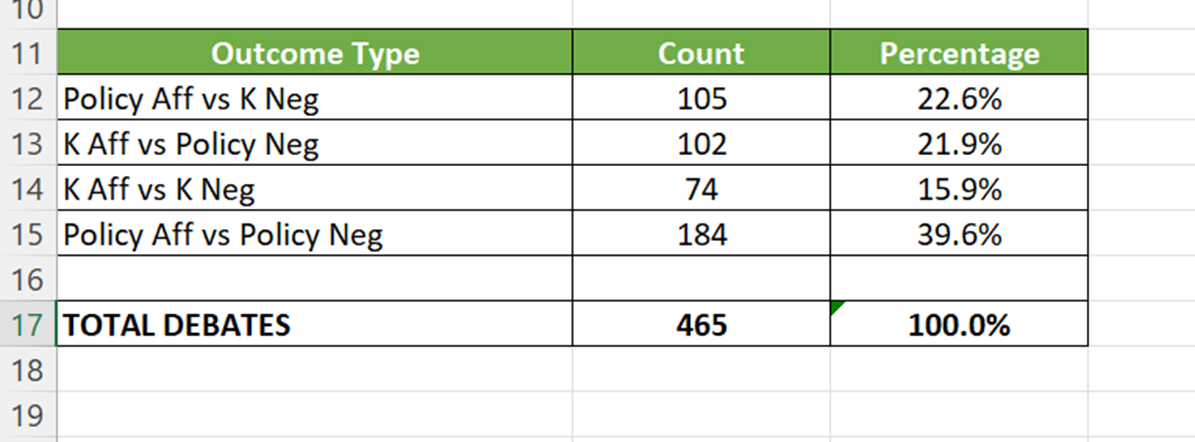
Lot of debates involving K stuff. Those numbers underrepresent the actual because of what I said above.
Debate is Fun
Debate is a fun game:
- You have opponents. They are smart. They want to beat you. Nothing like the live fire from an opponent who wants to step on your guts.
- Time textures everything. You are not doing essay writing where you can work on it until it is perfect. Your next tournament is coming up. There are only so many debates on a topic. Your speech is only 9 minutes long. And so on, and so on. The time limits of the individual speeches and the fact the number of debates is limited means there is an opportunity cost when you introduce something in a debate. Is this argument that takes 33 seconds to say better than this one that takes 22 seconds to say? No other game really forwards such a puzzle.
- It is you vs you: can you do all the little things correctly simultaneously to deliver a great speech? There is always room to challenge and push yourself even if your opponents in a particular round are not rising to the challenge.
I bring all this up because I heard a lot of “this argument is fun to go for,” “this argument is boring,” “that argument is bad,” “this argument is great,” “this team was bad,” “this judge screwed us.”
At best a lot of those comments were misguided, at worst it was just straight loser talk.
You don’t want to spend your mental energy moving teams and arguments around into meaningless buckets that are likely inaccurate in the first place. There are more important things to do like develop argumentative range, efficiency, actually back up your opinions with demonstrated expertise, and out-prepare and out-work your opponents on the substance.
New Arguments
This tournament was pretty dry in the elimination team meta. Lots of old Federal Workers matched with old Federal Workers Neg.
Emory GS did ban the plan for appointment clause reasons, an argument foreshadowed in these digital pages.
One team that bucked the trend and ripped off new arguments was MSU GL:
- New affirmative vs Long Beach in the octafinals about immigrants.
- AFL- CIO CP in the quarterfinals vs Federal Workers.
- They also read court politics about tariffs (someone could have read that before them)
- They read an Interbranch Conflict DA (which I am mainly pointing out because it is a personal favorite)
- They read a new version of Federal Workers in semifinals focused solely on the Foreign Service.
If I did not catch your flashy new argument, I would suggest two things:
- Use debatedocs for your debates
- Send me tip offs via email.
Competency Test
Cal MR vs Michigan BP in the quarter finals. This is a good one to think about for 2As.
Cal read their Data Workers affirmative with a new plan. Michigan read 9 off.
- 19 word ASPEC
- T-CBR
- T-subsets
- Antitrust CP
- MQD DA
- States CP
- ConCon
- Midterms DA (this had a preamble CP slated above it, but I do not recall if that actually got read).
- US Code CP
Then a secret 10th off which was 4 cards of dedev on the case. Michigan did not do this in the 1NC but they were prepared to force the link to dedev given the 1AC did not read an economic decline impact explicitly, but did claim to solve stuff that would be bad for the economy like grid collapse.
What does an enterprising 2A need to learn from this debate?
First, being able to answer a lot of off generally without blinking is a good skill to have. However, the part that trips 2As up for a long time is that it is not 9 off in a vacuum. It is 9 off that interact in a specific way. If I swapped out two of the off for other positions that should dramatically change the way you give the 2AC.
Second, you have to be able to identify: 1. What’s the ideal block the negative wants to give? 2. Are there acceptable plan B’s they could go for? 3. What am I going to dare them to go for?
Given the 1NC (which you can find on debatedocs) we know dedev is part of the ideal block. You don’t read the link to dedev for the affirmative if you are not serious. Michigan also went for dedev vs Berkeley BU in the doubles of NUSO. Jiyoon has gone for dedev, democracy bad and hegemony bad this year. They linked people to dedev quite a few times when they had nothing last year. I won’t put words in his mouth, but it is giving “impact turn guy.”
What do you pair with dedev? Dedev takes a lot of time to extend. It makes it harder to read positions that exist completely external to dedev after all the turns case stuff is done, given the position’s drastic assumptions about what type of society is desirable and necessary. So topicality would be on my radar. Similarly, these two teams have already had a T debate in the second round of Kentucky (Kentucky presets strike again. That preset was a quarterfinals preview!).
The other blocks that exist are states and midterms and…that’s it? ASPEC is fake. ConCon is fake. US code is a generic process thing where the only interesting question is how lightly can you cover it until you force Michigan to go for it. I assume MQD is fake but I would feel better about that opinion if I knew Michigan tendencies more thoroughly (something an enterprising 2A should know) and actually researched that DA.
Antitrust could be a thing maybe, but Michigan is not reading the net benefit from Gonzaga and it would really depend on the balance of research. I am not familiar enough with Cal’s aff to know how threatening antitrust is. I will say the internal net benefit as presented is fake because there is no mechanism for spillover + not a real terminal impact claim. Just a random lawyer riffing about antitrust as a body of law.
My preferred order would be: Dedev/case, T-CBR, T-subsets, ASPEC but only answer it with 18 words, States CP, Midterms, Antitrust, Code, Concon, MQD.
If you have never taken an afternoon working through giving 2ACs like this it can be quite hard. The 2AC in the debate, from my vantage point, did the following:
- Did not treat dedev as the most threatening position. Based on the balance of coverage I would say they treated Midterms and States as the most threatening position.
- Did not seem to use all their time effectively. There was jumping around and going back to pages at the end. That’s one of the things to eliminate through practice.
- Kept overall elements of 2AC terrorism low. Did not really create any headaches for Michigan I would say. That stems from not mucking things up across pages. Not attempting to exploit any interactions. Conditionality ultimately did not get read vs a 1NC with 5 CPs!
Things to at least consider doing:
- Dems bad for the economy, that messes with dedev.
- MQD is bad for the economy
- Read an econ DA as an add-on (generally not allowed in dedev debates, but Michigan forcing the link).
- Read a different econ collapse coming card on each CP. This has the additional side effect of potentially thumping Midterms if the 1AR connects those cards to an “economy determines the midterms” style card.
- Read conditionality. Being credible at extending it in the 1AR flips a competency test onto the negative which is giving a 2nr on substance and conditionality. Reading 5 CP’s to make going for dedev easier is the whole point of condtionality.
Very interesting puzzle that Cal had to solve. It would benefit all 2As to do practice against these big 2ACs because it is not enough to have frontlines and read them straight down. You have to synthesize and streamline what you are saying to inflict strategic pain on the negative, not just try to survive and cover.
A category of card that is helpful for dealing with situations like this but doesn’t come up in other contexts is a card that says your impact argument is pretty all-or-nothing: either it is causing catastrophic civilizational damage or it is not doing much of anything. This helps against teams trying to link your impacts to things while reading terminal defense to them and hoping their terminal defense doesn’t take out their link.
JV/Novice Elims During Varsity Prelims (#TrufGuestMusing)
Many tournaments, including Wake, use varsity judges who have completed their prelim commitments to judge JV/Novice elims even when those elims occur during varsity prelims. My request for today is: stop doing that.
The worst implementations of this choice land somewhere between baffling and outright disrespectful. Coaches attending debate tournaments are adults with a variety of demands on their time. Your prelim commitment should be a simple way to set a minimum amount of time that you will have free during the prelims. A person looking to plan around this does not care that the JV/Novice doubles is technically an elim. They care that they have lost two hours that their prelim commitment made it look like they would have for themselves. They care about being able to plan their overnight work based on knowing how much R&R time they will have on day two.
Obviously, counting the doubles as a prelim for commitment purposes would require upping round commitments. That is good. It is transparent. It allows you to treat prelim commitments as information about free time to work, do team logistics, and do whatever else you need to do. There is literally no offense from the judges' perspective, because the alternative is that you lose the same time except secretly.
To their credit, Wake warned people this would be how it works and 'compensated' affected judges by offering them Monday morning off. Lots of tournaments don’t compensate you and spring this as a surprise.
But this is clearly still second-best. It worsens the Varsity Octos and JV/Novice Quarters pools by shrinking them. It forces people who are in for zero because their job is to handle logistics to judge during a time slot where coaching and logistics demands often spike. It is opaque and unintuitive. Not everyone is dialed into the details of the schedule, especially if they don’t have JV/Novice teams of their own.
There is one DA to my proposal, which is that "elims" should be able to tap the whole pool to maximize judge quality. My 2AC:
- Tab knows how avoid "burning" rounds from highly preferred judges in order to save them for big debates. We already do this for bubble rounds.
- Achieving this by removing chosen judges from Monday morning defeats the point.
- Novice/JV prefs at most tournaments are significantly watered down (lower strike line, more tolerance for non-mutuality), making it very easy to create a doubles pairing that satisfies the pref system's baseline standard of quality.
Bottom line: if you are judging during a prelim, it should count from your prelim commitment.
Top 25 According to Me
As the semester comes to a close here is something that I am sure will not ruffle any feathers:
- Michigan BP
- Emory GS
- Kansas LS (Kansas is quarters, two semi’s and a win. Emory is two semi’s a final and a win and 2nd at the KYRR. Kansas is 1-0 vs Emory. Emory has surprisingly few head to heads vs Kansas and Michigan. Michigan and Kansas have debated each other a lot. These top 3 teams are in a tier of their own and very capable of beating each other)
- Georgetown AC (finals and KY RR win, their results are somewhat volatile BUT they do have wins against the top 3 + only really lose to the top 3 + beat the teams below them or have not hit them H2H).
- NU LR (elim depth comparable to MSU GL, but they are 2-0 against MSU)
- MSU GL
- CSU Long Beach MO
- Michigan SS (quarters twice)
- Emory LY (four elim wins, but some better H2H wins than Iowa)
- Iowa AP (four elim wins, but 2-0 vs Kansas OW)
- Kansas OW (four elim wins)
- Binghamton CK (three elim wins)
- Kansas HP (walked over twice, ouch)
- Berkeley MR
- Kentucky GS
- NU PS
- Michigan ES
- Emory RY (the no clear is tough for me, but they do have a quarters)
- Kentucky RW
- Dartmouth CG
- NU AT
- Emory KS
- Liberty CL
- MSU GS
- Iowa EW
Note - upon initial publication this list overlooked Kansas SS. I assembled my list based on latest elim reached and worked backwards. Their octafinal appearance at Gonzaga did not appear in this method because Tabroom results are poop + Kansas SS hit a Kansas team in doubles AND octafinals. Oops. Kansas SS has cleared at the 3 tournaments they went to with no misses. That puts them around #21 (Dartmouth CG does have an elim victory, NU AT has one too but does have a no clear.) My apologies!
Note #2 - Log another Tabroom results make this too hard. Emory GS is 3-0 vs Michigan BP. I did not clock that NUSO prelim at all. The plot thickens!
Good semester everyone. See you on the next side.