
Georgetown '26 Takes
A wild ride on and off the Zoom
We are SO BACK
I thought debate didn't have it in itself anymore, but was pleasantly surprised on Thursday/Friday to discover a good ole fashioned Facebook row began!
Here are the cliff notes:
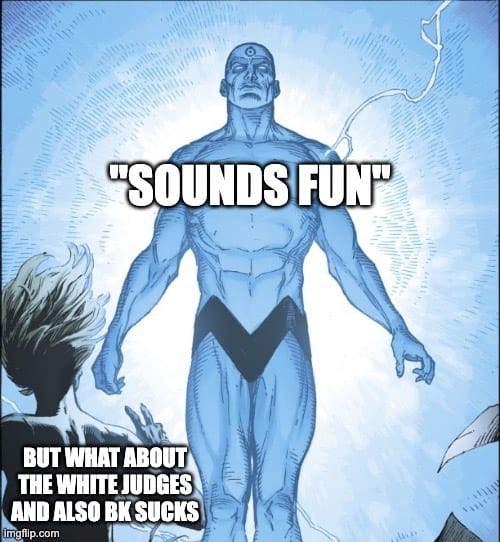
"Major League Baseball would never do this"
Let this be the north star that guides all our decisions in the future.
Highlights
Tagging BK to tell him he sucks. Rude/excessive, but I did chuckle. But it got weird after a while. And wow, did it go on for A WHILE.
The punctuation on this sentence that I think got deleted. Master class:
"And 2) I’ve heard various folks express interest over the years (off the cuff: various debaters, Azja, Mikaela, Bankey)—which, to be clear, is NOT to say that they suggested doing it at GU or anything like that—but regarding whether there is a “community consensus” in favor of it I have no idea: I am very interested in trying the experiment at our tournament—especially this year when we’ve agreed to shift online on behalf of the community, and have the luxury of more logistical flexibility etc.—and seeing how it goes."
Someone chiming in to say BK owes them money. BK responds to everything but that.
I will admit, I stopped caring around post 60 or so. So if anything really funny got said after that point, I probably missed it.
Old Facebook used to be better for seeing all the comments. The way they filter most relevant and order threads of comments is hella confusing to track. Don't remember when that change was implemented. Still had fun though.
Scoreboard
A comment thread started with:


We arrive here:
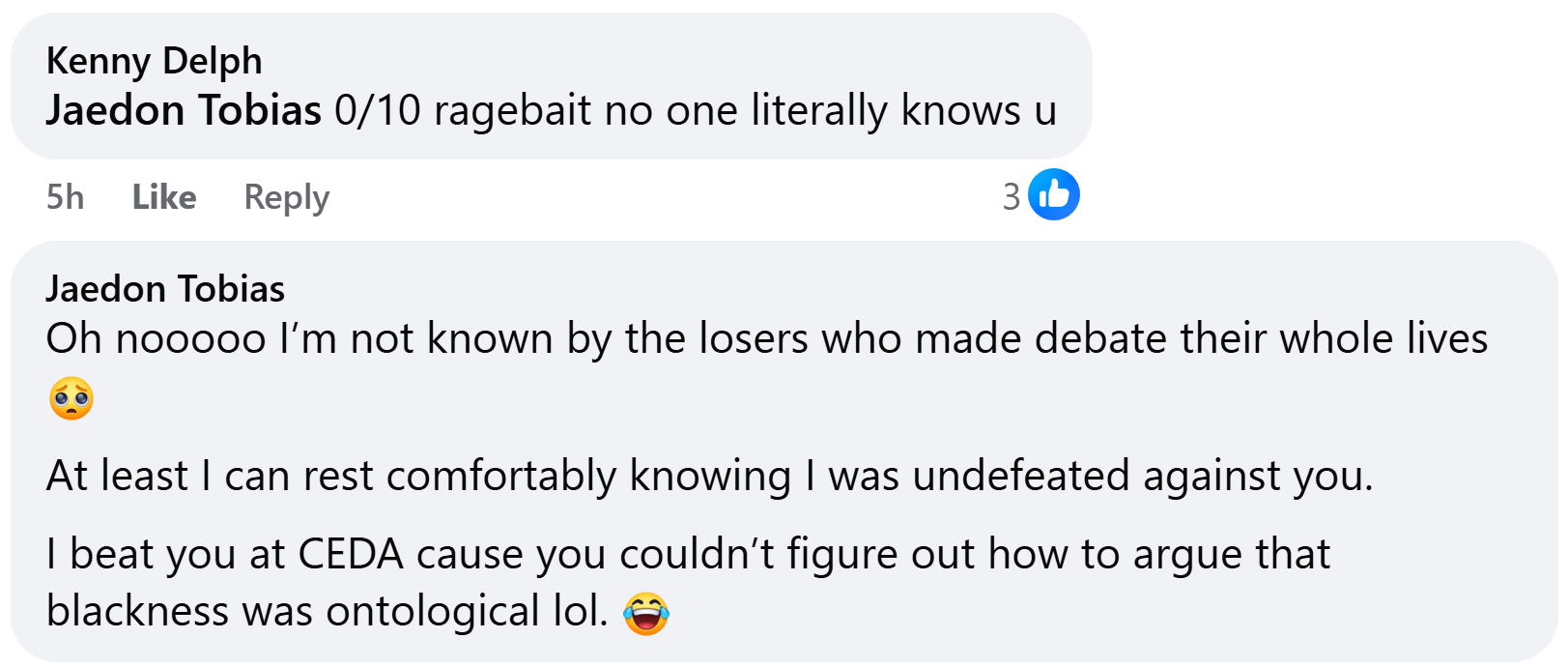
So, like, I had to look:

Damn, I guess.
The Actual Controversies
Should tournaments tell people how the tournament will work with more than 48 hours notice? Yeah, that sounds right.
Does the judging pool make elim challenges unfair? No, that does not sound right. The same teams do pretty good regardless of things such as these (see no prefs at Kentucky). The tournaments with the weirdest results are usually the Halloween one + Texas/the last one. Look it up.
Should the challenges start in the octafinals? That seemed like a weird choice, but have not thought about it much.
Would Major League Baseball ever let you pick your playoff opponent? No?? Not so fast!
 Joel Sherman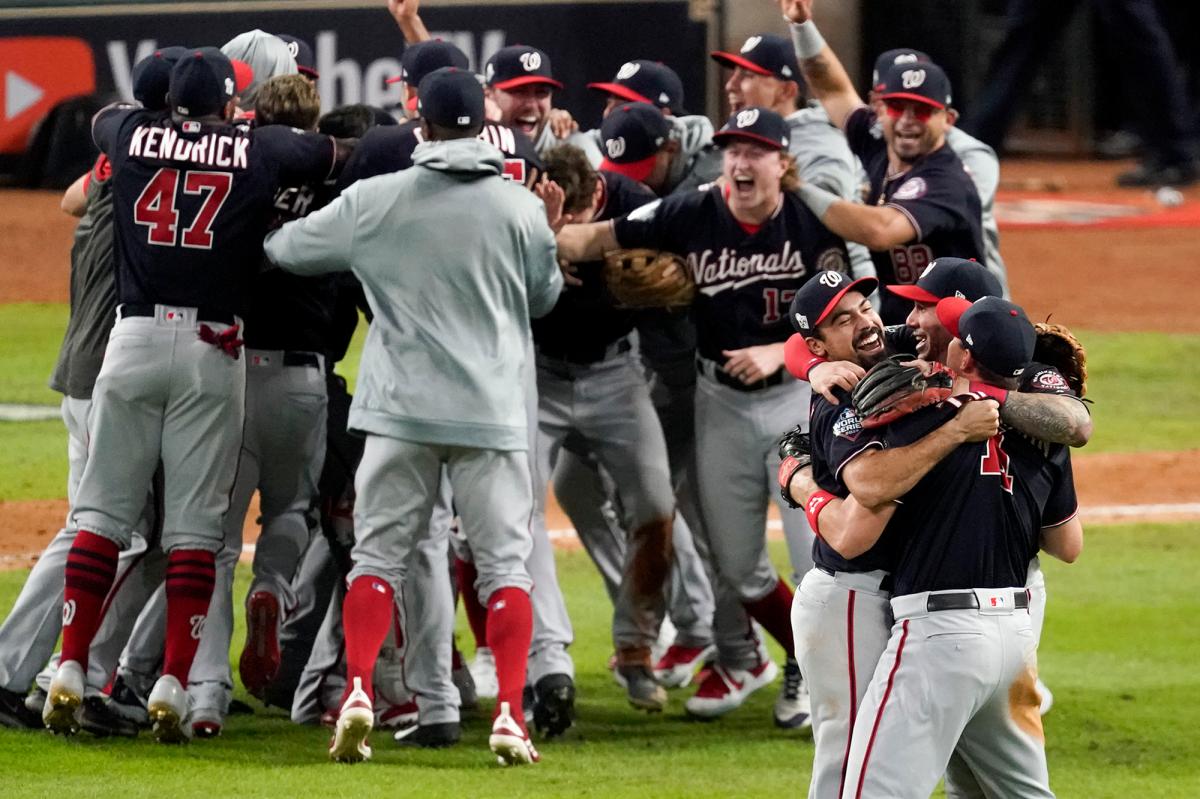
Is it better to do challenges at in-person tournaments? Yes.
Should tournaments with outsized influence on post-season awards just be randomly able to do stuff? Probably not, but that assumes debate is capable of collective action.
If you are doing elim challenges (so highest seed gets to pick their opponents etc), do you have to re-seed/let teams who win in upsets assume the higher seed? I am going to zag and say no. Make prelims matter and let there be a reward! But I do not really care about that one.
Do walkovers or lack thereof or something prove this whole thing is a farce? Was not really tracking with what people were saying, but the fact that everyone goes to tournaments that feature many walkovers does not make it seem like a great argument. If the universal norm was breaking brackets, whatever. But it is not!
Anyway, to the tournament!
Tournament Recap
Georgetown AC wins! They defeated Michigan SS for their first major tournament victory to pair with the Kentucky RR.
Does this propel Georgetown firmly into the Copeland race?? Head to Head birds will certainly squawk in protest.
Funnily enough only two debates occurred between the season's big three of Emory GS, Kansas LS and Michigan BP. Emory beat Michigan in a prelim and Kansas beat Emory in a prelim. It was a tournament for upsets with none of these teams making it further than the quarterfinals.
Still a lot to sort out at Dartmouth and Texas.
Congratulations to MSU FM for the breakout prelim performance! They went 6-2, beating Long Beach MO in Round 8. Going 6-2 or better for the first time is a big deal. This is why the tournaments should be 8 prelims!
51 different teams have now cleared across the five major tournaments. Congrats to MSU FM and Kansas MS for joining the club.
The Affirmative won:
- 8 of 14 doubles debates (57%, two walkovers)
- 3 of 8 octafinals debates (37.5%)
- 1 of 3 quaterfinals debates (33%, one walkover)
- 0 of 2 semifinals debates
- 1 of 1 finals debates
That is 13 of 28 elimination debates (46%)
Doubles Upsets:
#30 Kansas AU defeats #3 Emory GS
#23 Emory KS defeats #10 Baylor DL
#20 Kansas OW defeats #13 Berkeley BU
#19 MSU GL defeats #14 Binghamton CK
#18 NU PS defeats #15 MSU FM
Challenge Upsets:
#30 Kansas AU defeats #2 Michigan BP
#20 Kansas OW defeats #5 NU LR
The Great Plains are not to be trifled with.
#7 Michigan SS defeats#1 Kansas LS
Take that Great Plains.
#12 Iowa AP defeat #4 CSU Long Beach MO
More on challenges later.
WAIT A MINUTE
It was foretold - BK releases the rules on Thursday. Everybody said "we know who this benefits." Then, BK tries to shock and awe for over 130 Facebook comments?
And allllll the while Georgetown was winning the tournament!?
I'm not saying the fix was in. I'm just saying if I were saying that, the evidence would look exactly like this.
The Wiki and Debate Docs
Props as always to those that update their wiki before the next pairing drops.
Props to those that use debatedocs. My kingdom for teams that are willing to get the group on their debates when negative, not just affirmative. Maybe one day, with enough courage.
Slops to the free riders.
Slops to the edgelords that are too stubborn to share information efficiently.
Between the wiki and debate docs, I knew what happened in a larger percentage of elim debates compared to first semester tournaments.
I wish there was a team that ran the table on getting each of their debates on debatedocs, don't think there was.
Props anyway to Northwestern LR, they came close and routinely came in clutch at providing a debate I wanted to look at.
How Much Fiat
You see a DA that hinges on a card like this:

There used to be a whole subsection of debates focused on how much the affirmative gets to fiat. "Least necessary means" was one of the phrases, among others. If the affirmative says they fiat all three branches into agreement, thus there is no interbranch conflict, what does the negative say?
If the affirmative says they fiat Trump and he does not get pissy about the plan, what does the negative say?
Is it fart noises about how the negative went through "all this trouble" to produce this "DA" and it would be inconvenient for them if it was zapped with logic? Something else?
What is CX for if not this?
Negative reads the following:
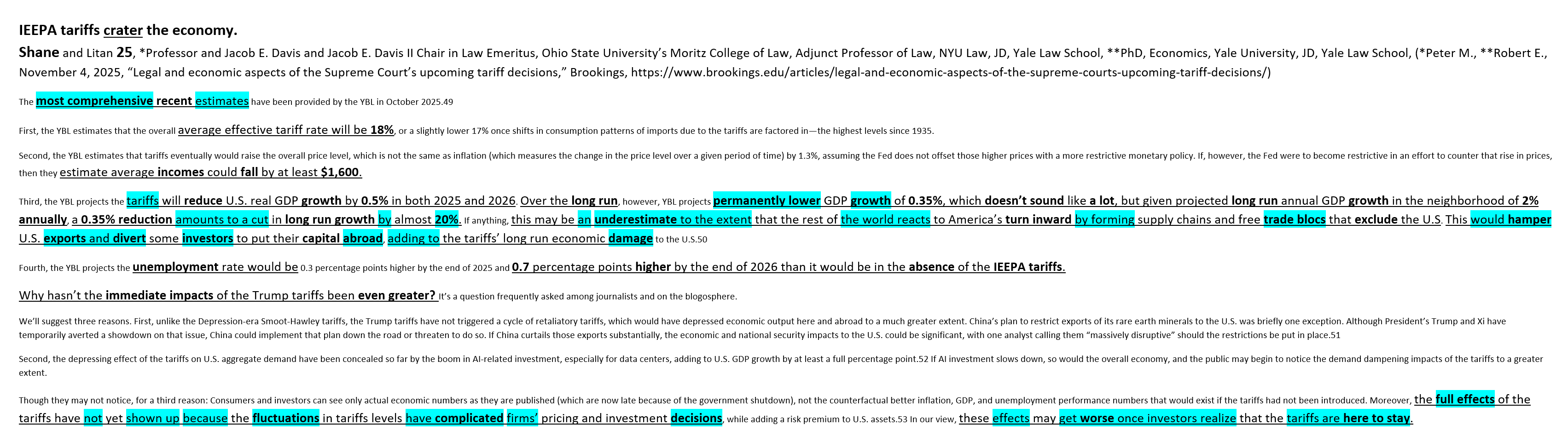
I have never been the biggest CX guy, but my appreciation for CX in theory grows in times like these. That is because the best use of CX is to make an opponent defend something silly while simultaneously making it easier and faster to bring up in actual speeches.
The fine print on this card is that the US is projected to grow 2% per year - indefinitely, it would seem, according to the text of the card. Tariffs reduce growth by .35% which the authors note is 20% of 2% if you round. Cool story.
So if you are keeping score that makes US growth a POSTIVE 1.65% per year. Then a global economic downturn bad card is read.
Now this example sets a low bar for the affirmative, BUT there is still some skill expression needed here. Are you just going to say "your first card says the US grows less good with tariffs, but you read a global economic decline card, what gives"?
Are you going to point to the fact that the US has grown at 2% or less in 2016, 2011, 2001 and 1990? What's the best way to land this plane?
A hope I have is if teams lose more in blowouts they will produce better arguments. CX shaming is an important part of that formula!
Fine Print

At first blush I thought: multi year military contracts already happened. 1NC card would agree with this.
So I suppose "Defense appropriations are key to Section 804" is doing all the heavy lifting here. Is that really substantiated in cards? No, but how could it be. Maybe they would point at this Lord 25 card complaining about how unpredictable the process has been to get NDAA's done? Boo hoo, mouthpiece of an organization founded by Elliot Abrams (youngsters, Google him and learn about Iran-Contra).
A preround check or check during the 1NC would quickly reveal the missile business is a-booming:
The Pentagon’s request comes after the annual production target originally set for 2027 was already reached years ahead of schedule. Lockheed Martin had been contracted to produce 650 missiles per year by 2027; based on output over the past three months, that rate has already been met.
But then this is the impact:

And this is despite us having more missiles currently? But the cagey adversaries know we could only blow up a given country for two weeks at a time, so they are doing whatever? But if we increase production to blowing up a country for an entire month every adversary caves?
And then people get upset if you give them lower than a 29.3? Slop!
Rock and a Hard Place
What is more important: a TSA with collective bargaining rights or an expansion of private security doing airport screenings?
Feast your eyes on this beauty.
Heritage card from 2015, sick.
Then this fucker:

Who has not written anything since 2019. Not suspicious at all.
This person wrote this line without a hint of sarcasm:
We face very real, persistent threats from adaptive adversaries who would use planes as weapons of mass destruction
Then a card that summarizes an FDD report that says Congress should fund the TSA bossing private actors around on cybersecurity more.
Then a card that says missile gap means wars (who knew this would be the most popular impact of the presets).
To seriously entertain what is going on here for personal learning for a moment because that is the alleged purpose of debate:
- A lot of other countries have a TSA-type body that sets rules, but then private actors handling the actual screenings in airports.
- The SPP is not really privatization or abolishing the TSA and is slow and stupid for other reasons beyond unions. TSA approves the private contractors. TSA manages the contract. It is not really devolving authority.
- The TSA obviously sucks. They are inefficient. But maybe will get slightly less stupid one day. The issue for the plane hijacking part of this DA is other reforms, mainly about accessing the cockpit of an airplane, have proven very effective at reducing an already small risk of hijacking.
- Could a cyber attack shut down air travel?
“cybersecurity experts give some of their highest marks to the Federal Aviation Authority, which reasonably separates its administrative and air traffic control systems and strictly air-gaps the latter.”
- I am going to have to do a deep dive on cyber impacts. I find them very corny. Stay tuned for that.
- Already made fun of the missile gap thing. I think this claim gathered a lot of steam in 2023 and beyond based on war games. Very funny to earnestly say "more missiles plz" after Trump did 626 bombings in 2025.
I wrote all the above on day 1. Little did I know how big a role the TSA would play in deciding the tournament.
Give it a Rest
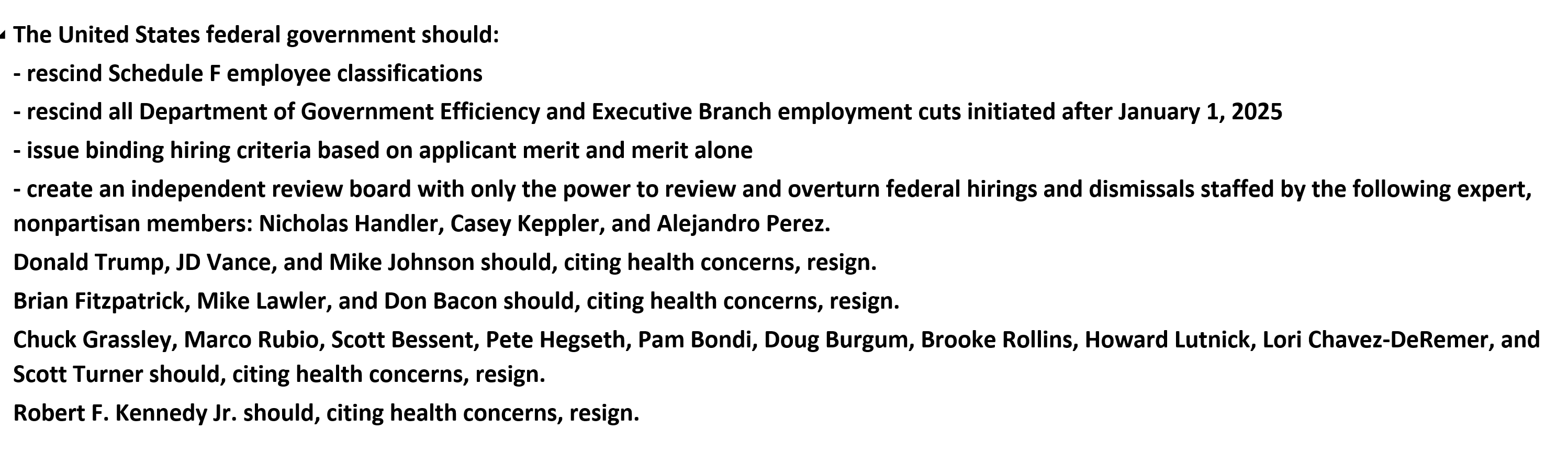
Sigh. They slated this card despite having Grassley resign too:

They read this card:

But forgot Transportation Secretary Sean Duffy existed? Or Energy Secretary Chris Wright? Both of whom are higher in the chain of presidential succession than whoever the neg thinks would become president?
If the negative introduced this argument facetiously, I apologize for my try-hard analysis. But assuming someone on the negative squad believed this represented clever thought, I must protest.
This all hinges on the affirmative being weak-willed and not attempting to exploit any of the logic introduced by the negative. The idea, one assumes, is that if the problem is the MAGA administration you want to thoroughly purge them. But, you can't just impeach and remove them for their rampant lawbreaking because... the 2AC will say that causes a civil war or MAGA would freak out (because MAGA wouldn't find the entire political leadership getting sick and perpetrating a self-coup suspicious in the slightest)? They will say it's a systemic rather than personalist issue (although this CP also has that problem)?
Barring drafting errors, how exactly is this CP supposed to work, anyway? Is the idea that the blue House will pick a blue speaker who then becomes president? A piece of trivia that may be relevant if this comes up again concerns "bumping": no one actually knows what is supposed to happen if everyone in the chain of succession is temporarily removed. If the House appoints a Speaker, that person has to resign their post in order to assume the duties of the President. Presumably that person would proceed to confirm a VP - but then, the VP is higher in the succession order than the former Speaker. Does the Speaker then have to resign because they have been "bumped", ceding their position to the duly appointed VP and becoming unemployed? No one knows!
Explaining the problems with a self-coup should not be difficult for a 1AC that is mainly about the importance of state capacity. There are obvious downside scenarios to the Republican party abdicating government and conditionality is the negative's only shield. Even if an entire 1AC boiled down to "Republicans are bad," an assumption I will not grant freely, does this kind of page provide any novel insight worth debating?
This is entirely bracketing the question of whether it is even legitimate to have people resign: this is not a policy and the "health concerns" the CP espouses really underscore the private nature of the act being suggested.
Name Change
I am reluctant to forward this because this could be an undue reward, but I think we have to refer to the teams that do the LD logic games as LD Riddlers going forward. So LD Riddlers Michigan CS, LD Riddlers Harvard DS etc. Many new riddles were composed for this tournament: 2As, be warned.
FAFO
Neg reads ACA subsidies agenda DA. Impact is access key to prevent pandemics.
Schumer not wanting to pass the PRO Act under Biden is a link, I guess?
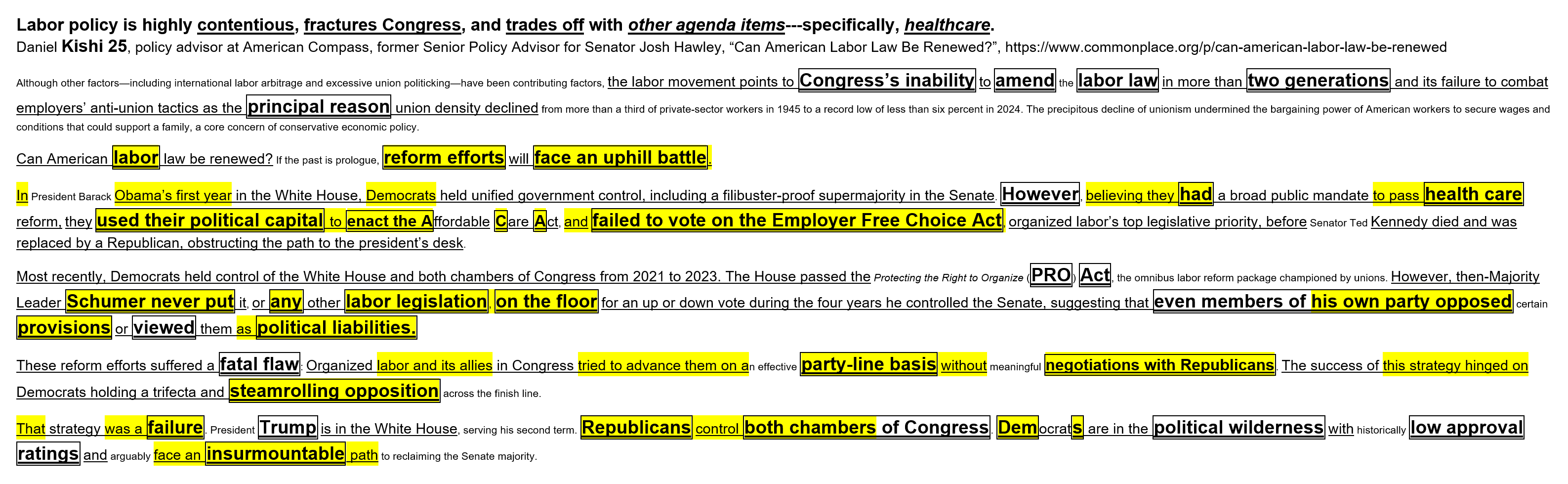
But we are here to highlight the 2AC saying:
- No deal on subsidies
- Rural healthcare is doomed
- Floor time is thumped
- No extinction from disease
- Appears intrinsicness and bottom of the docket got said.
No offense, no sneaky anything the 1AR can read 4 cards about, no defensive kill shots, no death by a thousand cuts.
Neg won this debate on the agenda DA. It can still happen in 2026!
Where's the Extinction?


New Affs
Round 3 - Macalester KW vs Emory GS - The United States federal government should substantially strengthen collective bargaining rights for workers in the United States by clarifying that prosocial bargaining is protected as a form of compensation or a working condition.
2NR = Cap K. Decision = Neg.
Round 4 - Emory GS vs Michigan BP - The United States federal government should substantially strengthen collective bargaining rights for temporary foreign workers in the United States through the Alien Tort Statute.
2NR = Court Curbing DA. Decision = Aff.
Round 6 - NU LR vs Emory GS - The United States federal government should strengthen collective bargaining rights with respect to algorithmic management.
2NR = Cap K. Decision = Neg.
Round 7 - Dartmouth CG vs NU LR - The United States federal government should clarify that the Immigration Reform and Control Act does not precede or repeal collective bargaining rights for workers in the United States.
2NR = Cap K + T technicality. Decision = Neg on the T thing.
Octafinals - Emory LY vs Georgetown AC - The United States federal government should substantially strengthen collective bargaining rights for workers in the United States by comprehensively regulating the enforcement of arbitration agreements for workers in the United States.
2NR = ILO CP. That means this = The United States Federal Government ought facilitate and support the filing of a complaint to the International Labor Organization’s Committee on Freedom of Association regarding the failure of strengthening collective bargaining rights for workers in the United States by comprehensively regulating the enforcement of arbitration agreements for workers in the United States.
Decision = Neg.
Finals - Georgetown AC vs Michigan SS - The United States Federal Government should strengthen collective bargaining for workers of the Transportation Security Agency.
2NR = Midterms DA + Employment Law CP
Decision = Aff.
Head to Head Sheet
Updated here: https://docs.google.com/spreadsheets/d/1BtN1M3Kja1pj1ClbN30wGqAgseypSd1NEoJfRi_XPJc/edit?usp=sharing
Negs With No Heart
What happened, negative teams? What happened to crushing old affirmatives? It is January and the affirmative is reading sectoral bargaining. Now is the time to unleash your superior researching and debating skills, right? Well, one example from round 8:
First off, ASPEC, no cards (ass)
Second off, EU CP written as follows:

Nonsense first plank, but ok, EU pressures for the plan with a real card. Allowed.
Third off, Solicitor General CP:
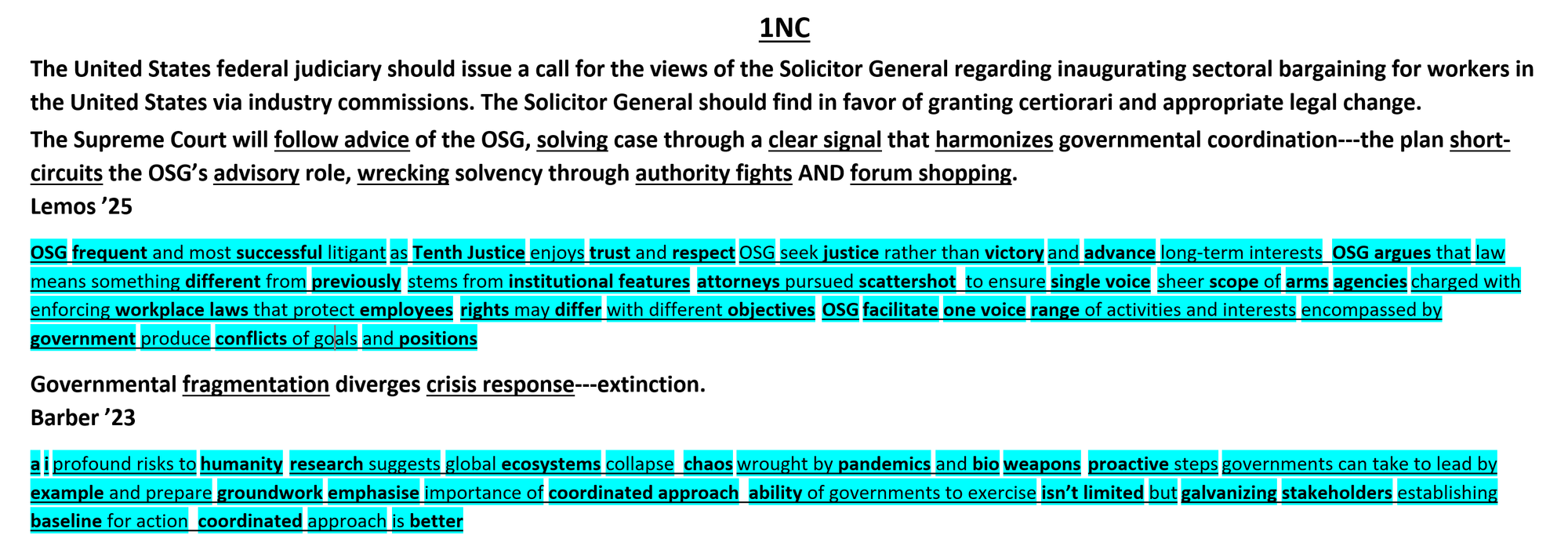
You are losing me. Why would Trump's Solicitor General recommend sectoral bargaining, something this CP does not fiat? Who in their right mind would say that the courts creating sectoral bargaining via industry commissions out of whole cloth is "appropriate legal change"? What is the CP granting certiorari to??? This is zero. Remember, we are debating a NUSO Round 1 affirmative.
Fourth off, Rates DA - oh but it needs a preamble CP. At least it is a DA. A NUSO generic DA, but a DA.
Fifth off, Permitting Reform Agenda DA - oh this one needs a preamble CP too:

I guess forswear is supposed to make the "don't pass it" plank okay because then it's a policy. But doesn't "forswearing" trigger floor time?
Speaking of which, the link is floor time! To what would be the biggest labor reform in a 100 years!
Energy leadership impact from 2019. Just delete from your computer.
Sixth off, States CP. Sure.
Seventh off, Midterms DA. Have not really read an argument specific to sectoral bargaining yet.
Eighth off, NLRB CP. Aff team must have committed some serious user error in committing to the NLRB adjudicating the plan's cases, otherwise there's clearly no reason a legitimate perm can't do the aff but transfer adjudications to Article III courts.
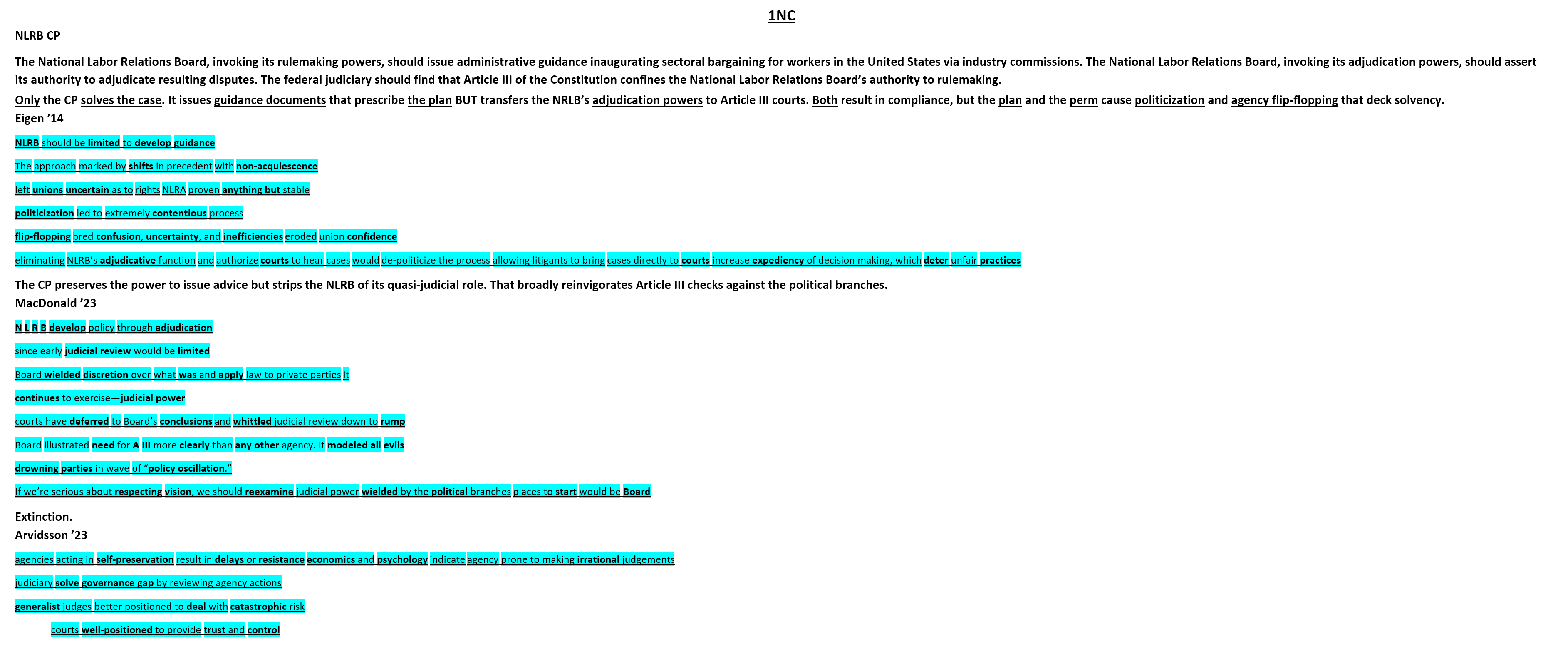
And courts can just take or leave the NLRB's "guidance" under the CP?
This kind of 1NC happened A LOT versus both old affs and new affs.
"Oh it was winter break" "Oh the labor topic is stupid" "Oh sectoral bargaining has never mattered"
That's all loser talk, obviously. There were 7 conditional things slated in this 1NC and zero cards that the plan was bad! I am not asking for the world here.
More importantly, people think researching and producing 1NCs like this is somewhere between passable and smart. It is a tragically widespread phenomena. The groupthink and mimicry is what we have to stop.
But, alas, the negative won this debate so what the fuck do I know?
Octafinals Challenges
The challenges began in the octafinals. The surviving seeds were #1, #2, #4, #5, #6, #7, #8, #9, #11, #12, #16 #18, #19, #20, #23, #30.
As you can see, 5 lower seeds won in doubles upsetting seed #3, #10, #13. #14 and #15.
#1 Kansas LS challenged #23 Emory KS. So Kansas picked a lower seed than 16 and the lowest seed available because #30 was from Kansas.
#2 Michigan BP challenged #30 Kansas AU, the lowest seed available. Bold move given Kansas just beat the #3 seed.
#4 CSU Long Beach MO challenged #18 NU PS. #19 was MSU GL (Dartmouth RR team) and #20 was Kansas OW. Interesting!
#5 NU LR challenged #20 Kansas OW. Back to chalk on lowest seed available
#6 Georgetown AC challenged #16 Emory LY. Skipping #19 MSU GL and picking a debate where Georgetown would be locked negative against a team that beat them in the elims of the Shirley and prelims of this tournament. This is the most grudge match pick of the bunch.
#7 Michigan SS (who had a bye in doubles) challenged #8 Berkeley MR. This was the biggest jump in opponent by seed. Michigan had 19, 12, 11, and 9 available but chose #8. Michigan was locked negative against Berkeley, one would assume that played a big part in the decision.
#9 Kansas MS finally displayed the courage necessary to challenge #19 MSU GL over the other potential opponent #12 Iowa AP.
That left #11 Kansas HP and #12 Iowa AP to debate in the final slot.
I had two reactions to how this went down.
First - if you reseeded each elim so highest seed debates the lowest seed, but you cannot produce a walkover, that would have been close to what happened but not quite. That would look like:
- Kansas LS/Emory KS
- Michigan BP/Kansas AU
- CSU Long Beach MO/Kansas OW
- NU LR/MSU GL
- Georgetown AC/NU PS
- Michigan SS/Emory LY
- Berkeley MR/Kansas HP
- Kansas MS/Iowa AP
Second - the only K team to select a policy team in the octafinals was Kansas LS vs Emory KS. Long Beach selected NU PS. Kansa HP and Iowa AP did not have a choice remaining. All the policy teams selected policy debates. This must certainly prove something to somebody about the real forces that drive debate!
Yearning

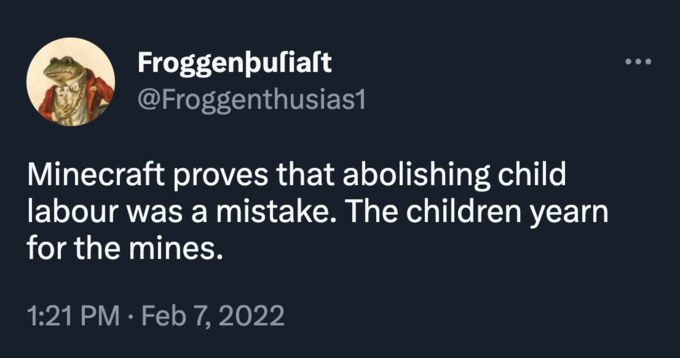
Kansas AU
There are those that knew what Kansas AU was capable of:

There are those that try and keep them down at every turn. Cough judges from the state of Georgia and Nick Loew cough.
And then there is McCaffrey, always just doing it live. The ultimate barometer I suppose.

Ok so I wrote the above during the octafinals. THEN KANSAS AU DID IT AGAIN!

A 30 seed beating the #3, already huge. Being challenged by #2 then winning again?? Incredible!!
It does kind of ruin the joke about Georgia judges, but I digress.
Kansas AU is not impressed with your weak, old ass affirmatives!
The Lost Art of Highlighting
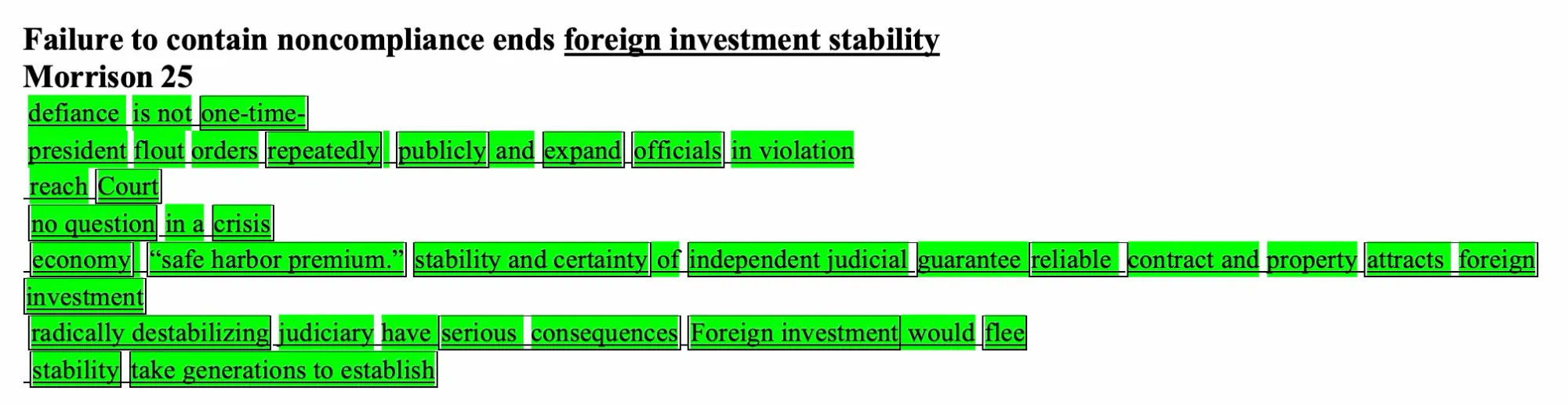
I believe a rising trend with judges is to look at your cards in highlight only mode. It is a positive one. This could cause some problems for some teams.
One team that demonstrated how it should be done is Kansas MS. As one observer put it:
cards are a crush for Kansas due to them highlighting in warrants and examples. a lost art of making cards say something that a judge remembers 2 minutes after reading it
See for yourself:

Quarters Challenges
Well well well, the quarters included four teams from the same school (Kansas). Have fun picking your favorite Kansas opponent, Beach and Georgetown.
But wait!! The picks were:
#1 Kansas LS picks #7 Michigan SS. Not the lowest seed Kansas could have picked, that would be #12 Iowa AP
#4 CSU Long Beach MO picks #12 Iowa AP. Not the lowest seed Long Beach could have picked because they could have picked Kansas teams. Hold that thought.
#6 Georgetown AC picks #30 Kansas AU. Nice knowing you Georgetown.
Which leaves Kansas MS and Kansas OW to hit each other??? Hello!?? Why is there a walkover? Why was Long Beach not forced to pick a Kansas team?
Facebook was right, this is all a poorly-thought-out farce!
T vs Federal Workers
Kansas is the best in the business at getting absolutely incredulous and whipping all their debaters into a frenzy over totally normal affirmatives.

I will say I appreciate anyone demonstrating that people can get got if they are caught napping. I wish it was not topicality-related, but still.
Is negative ground against Federal Workers so terminally bad that the only remedy is saying IT IS NOT TOPICAL??
Faithful readers of the blog will recall negative teams beating Federal Workers on:
- Article II arguments
- Court arguments like Curbing
- Deregulation good and Deregulation bad
- Movements DA
- Cap K
- Midterms
- European brain drain
- Ban the plan for various reasons
- Starve the beast
- CBR PICs
- Federal Unions will push for X bad thing if strong.
They also won on government flexibility good arguments. And when I say "they," I mean Kansas! In the Octas! Vs. MSU!
Faithful readers also know the negative has won more on this topic in general, but maybe all those wins were because judges pay off being a CRY BABY.
Here is a cool way to think about topicality. Thinking about it this way demonstrates the silliness of it all:
Fourth, a reasonability paradigm would help affirmatives to redefine the role of the judge. One of the central negative objections to reasonability interpretations is that they encourage judge intervention because the judge is left without a coherent standard to determine which interpretations are best. Affirmatives can flip this argument on the negative, however, by arguing that the offense/defense and competing interpretations paradigm exceeds the jurisdictional role of the judge. Traditionally, negatives argued that jurisdiction was a voting issue because judges could not vote to endorse a non-topical affirmative. The negative age calls for a judge to act as an arbiter of competing interpretations. That exceeds the role of the judge, however, because the negative is no longer demonstrating the affirmative is non-topical; rather they are only demonstrating that an interpretation that excludes the affirmative is comparatively better for debate. Topicality is a gateway issue which is meant to ensure that both sides have adequate ground for debate: if both interpretations provide similar quantity and quality of ground, then judges should dispense with topicality and allow the policy debate to begin.
The affirmative is topical if they meet a reasonable interpretation of the resolution. When affirmatives have strong support for their definition, based on traditional notions of limits, predictability, and field context, then judges should prefer that reasonable interpretation. In a legal context, when the words of a contract are ambiguous, a judge is required to interpret the term either by its ordinary meaning or its meaning as a term of art. Judges are not allowed to accept attorneys’ strained interpretations of what the words in a contract mean. When you think about this, the reason is very simple: each party has a vested interest in defining the words in the manner most beneficial to their case. The same is true in a debate. Topicality is a legal action of sorts to enforce the resolutional contract made between the parties, except in debate the parties have agreed that the words already have a somewhat ambiguous meaning. Each party has an incentive to define the words to best suit their particular interest, be it excluding or including the affirmative.
The judge in a debate sits in the role of either the affirmative’s savior or executioner. Topicality is a jurisdictional death penalty for the affirmative. Such punishment is not justified when an affirmative can craft an interpretation of the topic that preserves equitable ground for both sides and fosters the kind of policy discussion the resolution was written to induce. At a minimum, all of these arguments demonstrate that judges should hold negative interpretations to a much higher standard when affirmatives offer reasonable counter-interpretations.
Deceiving Looks
What is your first guess for how long that 1AC is? I said about 6 minutes.
Turns out it is 2473 words which is like 275 words per minute. Not a blazing pace but not slow.
There is one card that's 403 words and another that's 317, chonky!
You Son of a Bitch, I Am In!
As I was admiring the proceedings, my "debate is fun" thought this time around is about the back and forth struggle of it all.
Does the neg losing mean the argument they went for is bad? Or is the negative team the issue? Or some of both? Does the affirmative win because the aff is good or is the team just good? Or is that the negative is just not familiar or practiced enough sometimes?
You usually have to wait for elim day to see more cylinders start firing, but it is pure drama and comedy rolled into one when teams begin to lock in. New args, beatdowns, upsets, punts...the whole gambit was on display.
It was a pleasure to follow along.
See you next time.