
Dartmouth RR '26 Takes
I read every card and...just kidding.
Tournament Results
I wrote about the 2019 Dartmouth RR and didn't say anything about results. Oops. Not this time!
Emory GS wins! They went 6-0. Do you know what other teams went undefeated at the Dartmouth RR since 2004?
Click to reveal the answer
Michigan DP - 2024
Michigan PP - 2023
Emory GK - 2022
Emory KS - 2016
Michigan AP - 2015
Berkeley BP - 2011
Emory HW - 2008
Georgetown AC was 2nd going 4-2. Michigan BP was 3rd going 3-3.
The Affirmative went 11-10 in 21 debates.
Stay tuned to this page for a compilation of all recorded debates and ballots from this weekend!
Wiki Shout Outs
Props to those that used debatedocs and updated their wiki in a timely fashion.
For shame all those that did not even update the wiki yet. Boooooooooooooo!
Here are all the docs:
Is Winning Dartmouth a Good Sign?
I know every winner of Dartmouth since 2004. Do you?? I can also tell you there have been 3 instances of winning the Dartmouth RR and the NDT in the same year, can you name them??
Click to reveal the answer
Michigan DP (Dombcik & Phil) - 2024
Dartmouth TV (Tambe & Vergho) - 2021
Michigan State SS (Stahl & Strauss) - 2004
Don't start picturing that Larmon yet Emory! A long way to go.
New Affs Matching Game
Who Read What?
Which team read which new aff? Click an aff, then click the team.
New Affs - Evaluated
The NDT is coming. New affirmatives will be all the rage. Let's consider some factors that make a new affirmative good:
- You have to have a reason to read it beyond it is new. The first box you can check is it has some angle against the most likely generics the opponent will want to go for. This topic you have to seriously plan for the cap K among other generics.
- The impact work should be easily distinguishable from common negative defense.
- The impact work should be able to survive a CX.
- Ideally, you want to shrink the options for the negative as much as possible. Reasonably prepared negative teams against a new affirmative are going to try to find a lane as quickly as possible and just run right through it full speed. It is up to affirmative teams to make this as hard as possible.
- Some people would say it has to be very novel to the topic, but I am not so sure about that historically and I am really not sure about that this season given how people have interacted with old affirmatives. More on this later.
For reference here are the affirmatives I clocked as new:
- Agriculture Cooperatives – The United States federal government should remove the Agricultural Fair Practices Act's disclaimer clause, requiring good faith bargaining between distributors and antitrust-exempt farmworker collectives.
- NRC Workers - The United States Federal Government should restore collective bargaining for Nuclear Regulatory Commission workers in the United States.
- Supersede Statutory Interests - The United States Federal Government should substantially strengthen collective bargaining rights for workers in the United States by establishing that they supersede workers' contrary statutory interests.
- Religious Exemptions - The United States federal government should limit religious exemptions from mandatory collective bargaining with employees in accordance with the Religious Freedom Restoration Act of 1993
- Exclusive Representation - The United States federal government should eliminate exclusive representation for workers in the United States and substantially enhance enforcement capabilities for collective bargaining rights.
- Bankruptcy - The United States federal government should significantly strengthen rights to collectively bargain in good faith during bankruptcy proceedings.
- Neoliberal cabining - THUS, we reject the neoliberal cabining of labor law and political horizons, and therefore stand Resolved: that the United States federal government should substantially strengthen collective bargaining rights for workers in at least the United States.
I thought some of the areas were interesting like Statutory Interests and Exclusive Representation. I thought religious exemptions and agriculture were quantities you could figure out in the 1st semester. I am not sure any affirmative really achieved both of shrinking the negative's options and having well thought out impact work.
How it shook out:
- Religious exemptions = lost when broken, won a 2nd round.
- Ag cooperatives = lost
- NRC = lost
- Exclusive representation = won
- Statutory interests = won
- Bankruptcy = lost
- Neoliberal cabining = lost
More infinite prep! Back to the Aff mines!
Single Agencies
Believe MSU said federal workers everything new or something to that effect. They did that at Wake as well before reading Foreign Service.
Group chat guesses prior to the reveal:
- National Park Service
- Consumer Protection
- Department of Energy
Stupid Truf got closest by saying Department of Energy, boo.
I believe the tally is: Foreign Service, TSA and NRC on the season.
I believe NRC ran afoul of making it too easy for the negative to find a lane (nuclear power bad).
Neg vs New Affs
The holy grail is someone reads a new affirmative and the negative team has at least one specific thing either because they specifically predicted such an affirmative or by happenstance of doing a lot of research their tubs just filleth over.
Emory did this vs Michigan and Bankruptcy! They said the plan would specifically be bad for economy reasons, I will take it! They went on to go for the Security K, but shhhhh.
Northwestern beat NRC on T-Substantial! Will that mean anything to anybody?
Georgetown beat Michigan on court politics the 2nd time Michigan read bankruptcy. Obviously not quite neg vs new aff, but noted here.
Emory had two other affirmatives broken on them. Against Ag Cooperatives they went for New Affs Bad (boo, hssss) and a fiated DA we are calling the Delaware CP I think? Then against Neoliberal whatever they went for T and Psychoanalysis (truly the peanut butter and jelly of 2026, I am sure). Unclear to this writer at this time which one professor Callahan enjoyed more.
Reading Old at a RR
Need an official rule change that if you disclose old against an opponent at the RR you have to submit it in writing that you think they suck.
Ranking the Negative Blocks
There were 21 negative blocks at the Dartmouth RR. Let's take a moment to consider what makes a negative block good and fun.
I would say #1 for me is efficiency. There are layers to negative efficiency. Everyone should know basic ideas like 'the negative block is the only time you can develop your argument' and 'the negative should ratio the 2AC with cards' (2AC reads a card, negative reads 2 or 3 cards etc.).
I feel those principles lead debaters to debating the label of an argument more than the substance of an argument. I do not necessarily need 3 cards to answer an affirmative argument depending on what it is. Sometimes the affirmative could be trying to trap the negative by saying something silly that the negative could find ten ways to refute, but that does not mean the negative should.
Clearly negative teams can violate a principle of efficiency by reading evidence that does not add anything unique/does not build on what was said prior in the 1NC or even cards previously read in the same speech.
Negative teams can also undermine efficiency by being strategically redundant. This most often occurs in the instance of CP's and case defense. Imagine the block of 2NC = CP and case defense and 1NR = DA. The CP's only net benefit is the DA in the 1NR.
Some would teach you that this is two 2NR options. You can go for the CP and the DA or you can go for the DA and case. Those people would be like NFL coaches who say you have to establish the run before executing play-action passes. It is outdated/simple-minded conventional wisdom.
That negative block is one world where you have to go for the DA and then you have 9 minutes of defensive arguments to pick through because you do not have time for them all in the 2NR.
Is that a terrible negative block? Not necessarily, I suppose. Is it inefficient? Yes, particularly when you consider the fact that 2NCs are delivered without foresight to this notion that you are doing defense for 9 minutes and you will have much less time to dedicate to defense come the 2NR.
2NCs would be better off if they determined what is the best AND minimum amount of defense needed for the DA to win in the 2NR and then spend their time extending an actual second way to win the debate. The alternative is these giant defensive speeches where a meaningful portion falls by the wayside later in the debate due to time constraints.
Other principles of negative blocks:
- Specific stuff > generic stuff
- Offense > defense
- Some arguments are merely competency tests for the opposition. They can produce W's, but they will not win any style points on this blog.
- Topicality vs plans, snore. Go to Bricker's blog if you want credit for going for topicality vs plans.
- New arguments in almost all cases are at least some amount of fun. Some of the time they are not good, but producing, reading and extending new arguments is fun in 99% of cases.
Remember we have 21 negative blocks. Notes include:
- Eight involved topicality, rough.
- Capitalism, Buddhism, Security, Psychoanalysis and Bataille!! all made it into neagtive blocks. Buddhism and Psychoanalysis did it twice.
- Court politics appeared to be the process argument of choice.
- Kansas LS only extended the cap K once.
- Emory GS extended a K in all three of their negative blocks
- Block full of LD riddles. Gross.
What were the best negative blocks of this tournament? I would say:
- The ones with two ways to win that did not involve topicality or a K. Not that there is anything wrong with that, but given the specificity of the K's I cannot award any style points for that. I think the K wins at this tournament were more affirmative failing than negative winning. That leaves NU LR extending two DA's against Emory and Dartmouth extending a case turn and a DA against NU's religion aff the second time around.
- Gtown block vs NU breaking religious exemptions. 2NC not a lot of offense (double funny since the DA was Hollow Hope which has a built in solvency component) BUT there was a lot of stuff in the 2NC. And just beating a new Aff on a DA has to be highlighted.
- NU's block against MSU that did include topicality BUT also just included turns to the advantages about prolif and nuclear power. Pretty funny.
- Funniest block, it has to be noted, is MSU reading federal workers and Gtown deciding to just go for a massive pile of Bataille stuff, the aff card doc just being 1AC cards for the judge and MSU wins. Gtown - maybe consider putting the Bataille idea person in time out for the NDT.
Neg to Federal Workers
Emory defeats the DAs NU LR had lying around. Gtown went for Bataille, oops. Michigan goes for Buddhism against NU, takes the L. Federal workers is the anti-K aff!
I liked where Dartmouth's pile against Michigan was heading the most. I do think you can have a good civil service without unions, firing people can be good and flexibility could also be good.
MSU read and went for this:
The 50 states and all relevant territories should:
—enact a cause of action for constitutional violations committed by state, local and federal government officials and persons of the United States
—impose vicarious liability on governments, government officials, and persons of the United States for wrongs committed
—impose injunctive and compensatory remedies for constitutional violations by state, local, and federal government officials and persons of the United States
—clarify that qualified immunity is not a defense to liability.
With the following card to prove this is a thing:
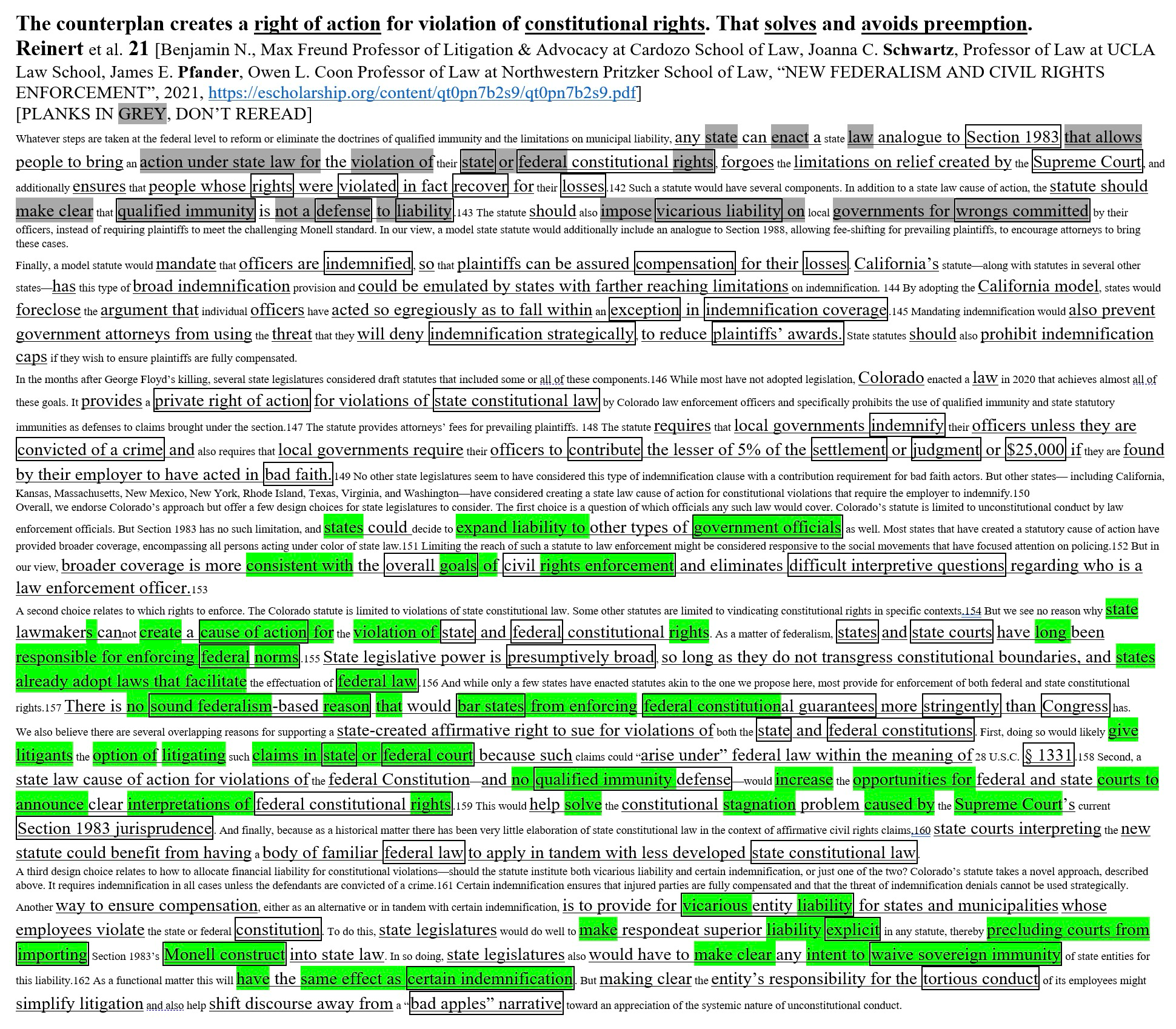
Let's set aside the basic drafting error that nothing in the CP says weakening federal worker CBRs is a "wrong" or a "constitutional violation" - the neg could fix this easily. If you are a 2A and you are presented with this for the first time, what are some things that could go through your mind that might lead you to the correct 2AC approach?
- You might notice that this CP's general idea is to allow people to use state courts to harass federal officials and the federal government, as well as whatever "impose vicarious liability on... persons of the United States" means.
- You might not know what vicarious liability is. Let's google it:
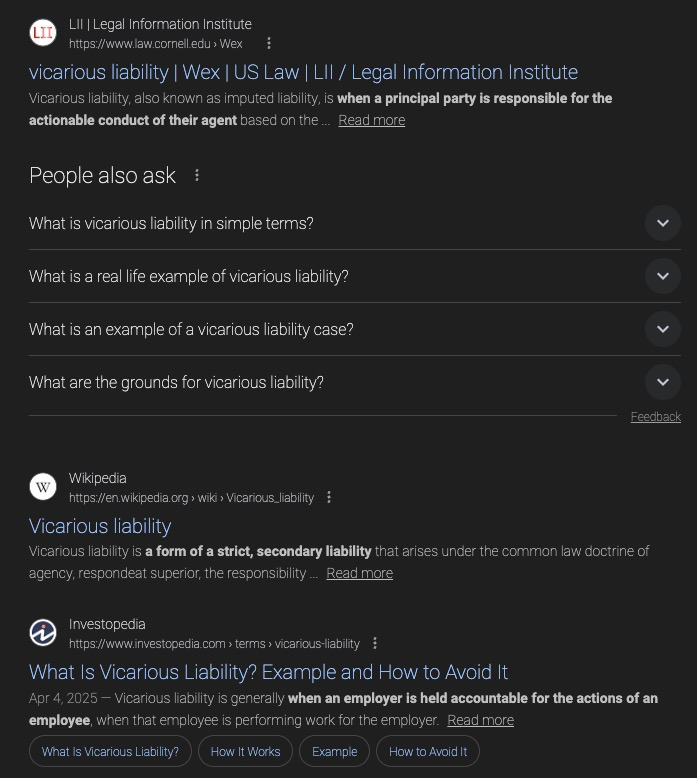
- So: it's when the employer is legally responsible for the employee. In this case, we're suing the federal government for illegal stuff its employees do.
- If you consult your pocket constitution (or have a hazy recollection of your high school government class) this description should be setting off some alarm bells related to the Supremacy Clause, which says:
"the Laws of the United States... under the Authority of the United States, shall be the supreme Law of the Land; and the Judges in every State shall be bound thereby, any Thing in the Constitution or Laws of any State to the Contrary notwithstanding"
- A good way to sniff out when someone is lying or mistaken about what an article says is when the argument being claimed is extraordinary, the author of the article appears to be competent, yet the author of the article does not seem to acknowledge the extraordinary nature of their argument. In this case, we have a proposal that seems like it would run up against a fundamental Supremacy obstacle purportedly being supported by a smart person who devotes a single sentence to waving away federalism concerns, noting there is "no sound federalism-based reason" to oppose it. Something fishy is afoot.
- Let's read more closely:
Whatever steps are taken at the federal level to reform or eliminate the doctrines of qualified immunity and the limitations on municipal liability, any state can enact a state law analogue to Section 1983 that allows people to bring an action under state law for the violation of their state or federal constitutional rights, forgoes the limitations on relief created by the Supreme Court, and additionally ensures that people whose rights were violated in fact recover for their losses.142 Such a statute would have several components. In addition to a state law cause of action, the statute should make clear that qualified immunity is not a defense to liability.143 The statute should also impose vicarious liability on local governments for wrongs committed by their officers, instead of requiring plaintiffs to meet the challenging Monell standard. In our view, a model state statute would additionally include an analogue to Section 1988, allowing fee-shifting for prevailing plaintiffs, to encourage attorneys to bring these cases.
While most have not adopted legislation, Colorado enacted a law in 2020 that achieves almost all of these goals. It provides a private right of action for violations of state constitutional law by Colorado law enforcement officers and specifically prohibits the use of qualified immunity and state statutory immunities as defenses to claims brought under the section.147
- Aha! We're talking about suing STATE governments and officials for state and federal constitutional violations in state court - not suing the FEDERAL government or FEDERAL officials in state court.
- Is that even a thing? Let's Google "can you sue the federal government":
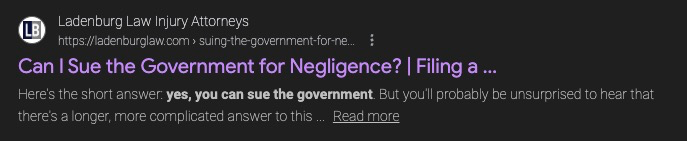
The Federal Tort Claims Act (the “FTCA”) is a law that passed in 1946, allowing individuals to sue the government for specific tort claims, just like you’d sue a regular person or a business. Now, here’s the thing: the government usually has this protection called “sovereign immunity,” which shields it from a lot of legal drama. Before the FTCA came along, if the government caused you harm, you were pretty much out of luck in seeking compensation.
- Googling "federal sovereign immunity". Bingo:
Any lawyer who practices regularly in the federal courts eventually will encounter the federal government as a party and will learn, as the Supreme Court stated nearly sixty years ago, “[i]t is too late in the day to urge that the Government is just another private litigant, for purposes of charging it with liability.” The United States is hardly a typical litigant, as it benefits from a plethora of special procedures, defenses, and limitations on liability not available to others. Indeed, the federal government may not be subjected to suit at all absent its own express consent pursuant to the doctrine of federal sovereign immunity. This article addresses that doctrine.
We have landed on a card that would surely defeat this position and can be introduced as late as the 1AR so long as we say something about preemption in the 2AC.
Why do we do this?
- Preamble CPs that are never spoken about again
- Preamble CPs that do the DA and not the DA which makes an entire farce of any notion of DAs being intrinsic
- New affs bad
- LD riddles
- Affirm your authentic self as the alt to psychoanalysis
We have lost our sense of shame. We must find it again.
Best Bye
Most would say first round of day 2. Going to zag and say last round. Just get it over with and start having fun. Maintain solid momentum and pacing throughout.
New Aff Patterns & Advantage Bottlenecks
Questions I would be asking if I was in charge of negative preparation for the NDT, in no particular order:
- So Dartmouth's ag affirmative talked about the Packers and Stockyards Act, the Capper-Volsted Act, and the Agricultural Fair Practices Act. So that means there are probably other laws in other sectors of the economy like that. Do we know all of them? That is one way to smoke out new affirmatives before they happen.
- What is the strategy if the affirmative has to win union density goes up? Can we prove it takes a long time? What short-term offense are we going to produce?
- What are the advantages that do not rely on union formation or union density?
- Does it matter what the affirmative is if the advantages bottleneck into inequality, ag/food, tech innovation, supply chains etc.? Can we write a strategy based on the impact area?
- The type of strategies that worked the most against federal workers was: fiat in a DA + defense and alternatives to unions + some union bad/flexibility type argument. Can we apply the effective themes from federal workers to other sectors of the economy, other small areas of the topic.
- Are we ever going to cut specific K cards to make our generic look better against new affirmatives or are we just going to bank on the affirmative falling on their face?
No one writes Neg to Old and it shows
One would think this is where having a big debate team is the most unfair. Like having a bunch of 5 star recruits on a college sports team. The analogy breaks down when you come to understand that big squads do not have 20 people that can adequately destroy an old affirmative.
Sometimes it is easier to make slight upgrades to an old affirmative and be able to predict what a team is going to say then breaking whole new ground.
Some teams still haven't figured out how to optimally beat Federal Workers despite debating it a million times as a squad. Not sure I would dismiss an affirmative because another squad beat you to it. Depends how you want to put your opponents to the test.
See you next time!