
Can 1ACs Speak?
Trends in 1AC writing to inform affirmative and negative strategy
I wanted to think deeper about writing policy 1ACs. I collected 36 1ACs from the college CBR topic. I analyzed them from a variety of angles. Here is what I discovered.
1AC Speed
While I was doing this, I thought I might as well figure out the word count of these 1ACs and divide by 9. I could not do this for all the 1ACs I collected because some teams out there have just unholy demons living in their Verbatim. I have Truf as a collaborator and even he couldn’t undo the nastiness in some of these documents.
I am not naming any teams, *cough* Texas FL, GMU WW and UTD PR *cough*, but some of you need to find God (download a fresh version of Verbatim and burn some of your backfiles). We will release a tool that tries to clean up your document formatting automatically soon.
The average speed was 295 words per minute. That did include a big outlier in USC BR who clocked in at 206 words per minute?? (I think my 6 year old was clocking Mercy Watson pig books at 210 - something weird likely going on here with the word counter). But removing USC only makes the average go up to 298.
| Team | Words Per Minute |
|---|---|
| Dartmouth CG | 279 |
| Emory GM | 331 |
| Emory GS | 324 |
| Emory KS | 324 |
| Emory LY | 329 |
| Emory RY | 295 |
| Gtown AC | 320 |
| Harvard DS | 300 |
| KU AU | 308 |
| KU BW | 294 |
| KU OW | 317 |
| Kentucky GS | 294 |
| UM AO | 314 |
| UM BP | 317 |
| UM CC | 244 |
| UM ES | 285 |
| UM SS | 288 |
| MSU GL | 302 |
| MSU JS | 296 |
| NU AT | 293 |
| NU LR | 298 |
| USC BR | 206 |
| Stanford LL | 264 |
| Cal RM | 266 |
| Cal UB | 283 |
| Average | 295 |
So 320 to 330 seems to be pretty fast. If you are anywhere between 280 and 300, you are probably doing just fine. If you are below 280 at the moment you may need to get into the lab and get that speed up a little so your opponents do not have an edge.
How many advantages?
Four 1AC’s had 1 advantage.
Two 1AC’s had 3 advantages (Harvard doctors, Michigan ES secondary strikes. Maybe Dartmouth has done it, but not on the one I clicked on).
The rest had 2 advantages. That is by far the most popular form.
How many impacts?
This is where things get a little squishy. The way people think about and refer to impacts varies. For my purposes I was looking strictly at distinct terminal impact claims. For example, democracy solves public goods where “public goods” is like 7 things is not 7 impacts. Moreover, if a 1AC said autocracy causes war and democracy provides public goods I believe I wrote that down as a single democracy good impact.
- The average = 5.66
- The mode = 4
- Highest = 9 (Michigan SS federal workers)
- Lowest = 3 (Michigan AO secondary strikes, UTD PR Data, Emory GM sectoral bargaining)
What percentage of a 1AC is dedicated to impact cards?
| Team | Affirmative | Total Cards | Impact Cards | Impact Card % |
|---|---|---|---|---|
| Cal BU | Data Workers | 24 | 6 | 25% |
| Cal MR | Data Workers | 20 | 5 | 25% |
| Dartmouth CG | Sectoral Bargaining | 20 | 7 | 35% |
| Emory GM | Sectoral Bargaining | 21 | 6 | 29% |
| Emory GS | Doctors | 32 | 13 | 41% |
| Emory GS | Federal Workers | 32 | 15 | 47% |
| Emory GS | Secondary Strikes | 30 | 12 | 40% |
| Emory KS | Federal Workers | 31 | 15 | 48% |
| Emory LY | Federal Workers | 31 | 15 | 48% |
| Gtown AC | Automation | 28 | 11 | 39% |
| Gtown AC | Federal Workers | 30 | 14 | 47% |
| Gtown AC | Gig Economy | 25 | 10 | 40% |
| Gtown AC | Journalism | 25 | 11 | 44% |
| GMU WW | Antitrust | 25 | 8 | 32% |
| Harvard DS | Doctors | 33 | 8 | 24% |
| KU AU | Sectoral Bargaining | 24 | 6 | 25% |
| KU BW | Sectoral Bargaining | 21 | 5 | 24% |
| KU OW | Federal Workers | 24 | 7 | 29% |
| Kentucky GS | Sectoral Bargaining | 22 | 9 | 41% |
| UM AO | Secondary Strikes | 25 | 7 | 28% |
| UM BP | Automation | 28 | 13 | 46% |
| UM BP | Gig Workers | 27 | 10 | 37% |
| UM BP | Takings | 25 | 7 | 28% |
| UM BP | Secondary Strikes | 25 | 7 | 28% |
| UM BP | Glacier Northwest | 28 | 10 | 36% |
| UM CC | Gig Economy | 22 | 6 | 27% |
| UM SS | Glacier Northwest | 27 | 10 | 37% |
| UM SS | Federal Workers | 26 | 14 | 54% |
| MSU GL | Federal Workers | 25 | 7 | 28% |
| MSU JS | Federal Workers | 22 | 7 | 32% |
| NU AT | Federal Workers | 28 | 10 | 36% |
| NU LR | Federal Workers | 28 | 10 | 36% |
| Stanford LL | Federal Workers | 22 | 8 | 36% |
| Texas FL | Antitrust | 22 | 5 | 23% |
| UTD PR | Data Producers | 13 | 3 | 23% |
| MSU GL | FSOs | 22 | 8 | 36% |
- Average = 35%
- Mode = 28%
- Highest = 54%
- Lowest = 23%
What does it mean that a certain amount of the 1AC is spent on terminal impact claims? There are two more things to consider.
How developed are these impacts?
Development is defined by the following: did the 1AC read any additional evidence, after introducing an impact claim, which was designed to preempt a negative argument? For example after saying climate change causes extinction, one might read a card that says adaptation won’t be enough. That climate impact is considered “developed.”
From the 36 1AC’s analyzed I would say 21 did not do this for any impact in the 1AC. It was one and done on impact evidence. The schools most likely to do this are Emory, Northwestern and MSU (I do have a couple Michigan 1ACs noted as well).
58% of the 1ACs had one piece of evidence per impact. Interesting. One last question.
How many internal links do these impacts flow from?
Originally, I did not note this. As I thought more about strategic implications this became a relevant question. I read one 1AC with this in mind and almost balked at the task for being too cumbersome (1ACs don’t make it super obvious at a glance how distinct their internal link claims are). But I persevered! Anything to be a completionist with my gimmicks.
- Average = 2.44
- Mode = 2
- Highest = 4
- Lowest = 1
Internal links in a vacuum don’t really tell you anything if you do not know the ratio of internal links to impacts.
| Team | Affirmative | Distinct Impacts | Internal Links | Impacts to IL's |
|---|---|---|---|---|
| Cal BU | Data Workers | 4 | 4 | 1.00 |
| Cal MR | Data Workers | 4 | 4 | 1.00 |
| Dartmouth CG | Sectoral Bargaining | 6 | 3 | 2.00 |
| Emory GM | Sectoral Bargaining | 3 | 3 | 1.00 |
| Emory GS | Doctors | 5 | 4 | 1.25 |
| Emory GS | Federal Workers | 8 | 3 | 2.67 |
| Emory GS | Secondary Strikes | 4 | 1 | 4.00 |
| Emory KS | Federal Workers | 8 | 3 | 2.67 |
| Emory LY | Federal Workers | 7 | 3 | 2.33 |
| Gtown AC | Automation | 8 | 2 | 4.00 |
| Gtown AC | Federal Workers | 7 | 4 | 1.75 |
| Gtown AC | Gig Economy | 6 | 3 | 2.00 |
| Gtown AC | Journalism | 8 | 2 | 4.00 |
| GMU WW | Antitrust | 8 | 3 | 2.67 |
| Harvard DS | Doctors | 6 | 2 | 3.00 |
| KU AU | Sectoral Bargaining | 5 | 2 | 2.50 |
| KU BW | Sectoral Bargaining | 4 | 2 | 2.00 |
| KU OW | Federal Workers | 5 | 2 | 2.50 |
| Kentucky GS | Sectoral Bargaining | 6 | 2 | 3.00 |
| UM AO | Secondary Strikes | 3 | 3 | 1.00 |
| UM BP | Automation | 7 | 3 | 2.33 |
| UM BP | Gig Workers | 4 | 2 | 2.00 |
| UM BP | Takings | 7 | 2 | 3.50 |
| UM BP | Secondary Strikes | 4 | 2 | 2.00 |
| UM BP | Glacier Northwest | 8 | 2 | 4.00 |
| UM CC | Gig Economy | 4 | 2 | 2.00 |
| UM SS | Glacier Northwest | 8 | 2 | 4.00 |
| UM SS | Federal Workers | 9 | 4 | 2.25 |
| MSU GL | Federal Workers | 5 | 2 | 2.50 |
| MSU GL | FSOs | 5 | 1 | 5.00 |
| MSU JS | Federal Workers | 4 | 2 | 2.00 |
| NU AT | Federal Workers | 5 | 2 | 2.50 |
| NU LR | Federal Workers | 5 | 2 | 2.50 |
| Stanford LL | Federal Workers | 6 | 2 | 3.00 |
| Texas FL | Antitrust | 5 | 2 | 2.50 |
| UTD PR | Data Producers | 3 | 1 | 3.00 |
The way 1ACs are commonly discussed masks the best way to think about them. “They read two advantages,” or “They read 8 impacts.” Those two things do matter. Sometimes the advantages are on separate pages but share internal links. They have 8 impacts, but they all come from 2 internal links. That seems more relevant for strategizing.
Bringing it Together
What does any of this information have to do with anything?
For the affirmative:
- Ratio. The ratio of internal links to impacts is important. If you create a bottleneck at the internal link, CP’s and solvency arguments that target said internal link become more appealing.
- CP answers. Each internal link read presents a potential unique answer to a CP.
- Sufficiency. Reading too many internal links opens the door to one being taken out and that being proven sufficient to nullify the advantage.
- Diminishing returns. There are diminishing returns to reading impacts stemming from the same internal link. In such a 2AR you have to argue your advantage stem no matter what. Arguments uniquely related to your first impact claim will probably refer to the magnitude of said impact. If multiple impacts were present in the 1AR you will be able to determine which one was covered the least and/or was challenged by the lesser arguments. What relevant gain do you secure by talking about more than one impact from one internal link?
Given this end state, the relevant question for the 1AC is: what is the optimal balance between presenting impacts to probe your opponent’s argumentative weaknesses and generate time imbalances vs creating a bottleneck at the internal link that will push them into trying to nullify your impacts through other means?
Given the chart from the previous section I think if your ratio of impacts to internal links is ABOVE 2.0 that is not good. That is too many impacts that are not helping achieve any particular goal beyond making the negative spaz (which is not nothing, but better priorities exist).
The most threatening 1AC’s to me, based off that chart, include:
- Berkeley – 4 impacts and 4 internals
- Dartmouth – 6 impacts and 3 internals
- Georgetown – 7 impact and 4 internals
- Quality vs quantity. The other tradeoff you have is that reading additional impacts prevents you from developing your initial impacts.
The arithmetic here is pretty simple. Most 2As do not plan to read additional impact evidence on the case after the 1AC (though it is worth noting that there are many situations where you might actually want to depart from this conventional wisdom). Meanwhile, most 2Ns plan to read 1-2 pieces of defense in the 1NC and add 1-2 additional pieces of defense in the 2NC. A 1AC that has one impact card might get outcarded by the 1NC and will be dramatically outcarded by the block. If you know what defense is likely coming and have developed your 1AC accordingly, there’s a chance that you remain ahead on card count throughout the debate.
Neg impact defense can mostly be described as “aff thing won’t happen at all” or “if aff thing starts to happen it will go differently than the aff says.” Developing against the first is straightforward: figure out why the neg says your prediction is wrong, and add arguments that counteract this. Why are your studies good while the neg studies are bad? Why does the neg argument assume a different variant of your impact than you are talking about?
Developing against the second provides more room for creativity. To be clear, we are talking about arguments like:
- Crisis won’t cause war, people will back down.
- Disease will burn out, not kill everyone.
- One nuke might be used but the war won’t become terminal.
Now imagine that your 1AC has followed up its original impact arguments with cards like the following:
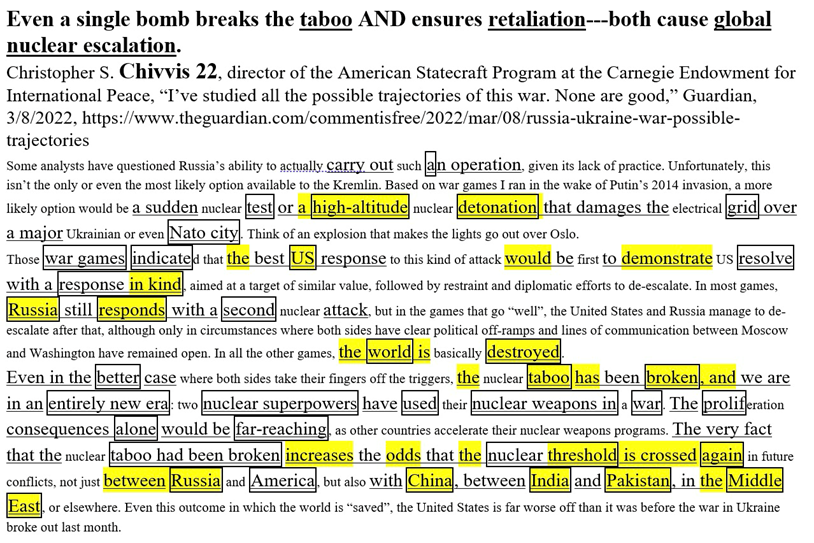
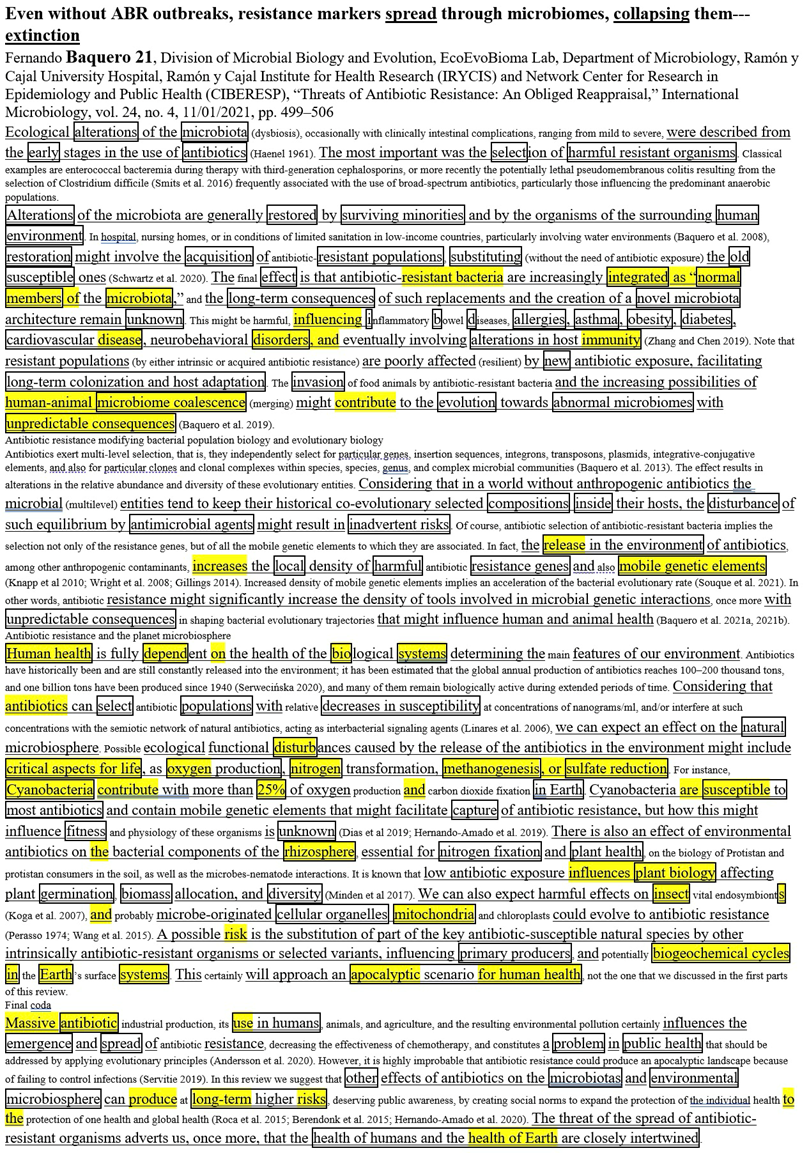
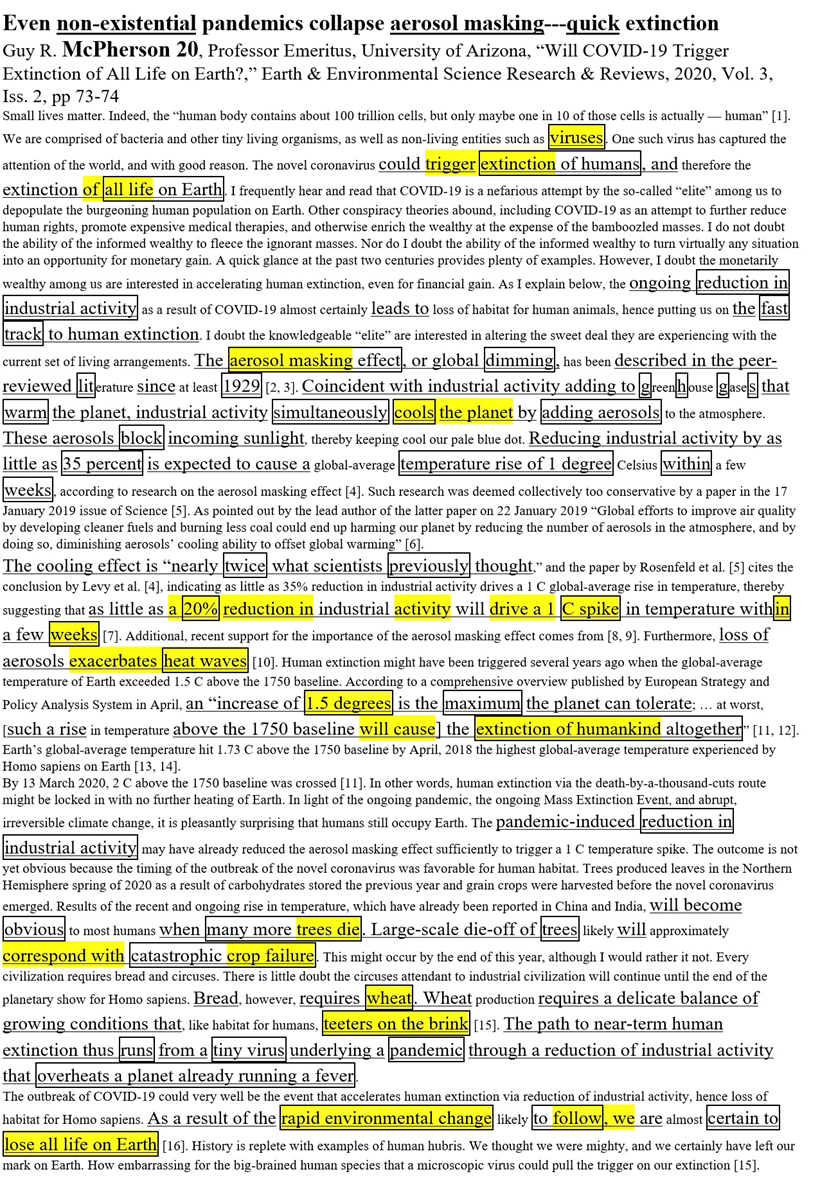
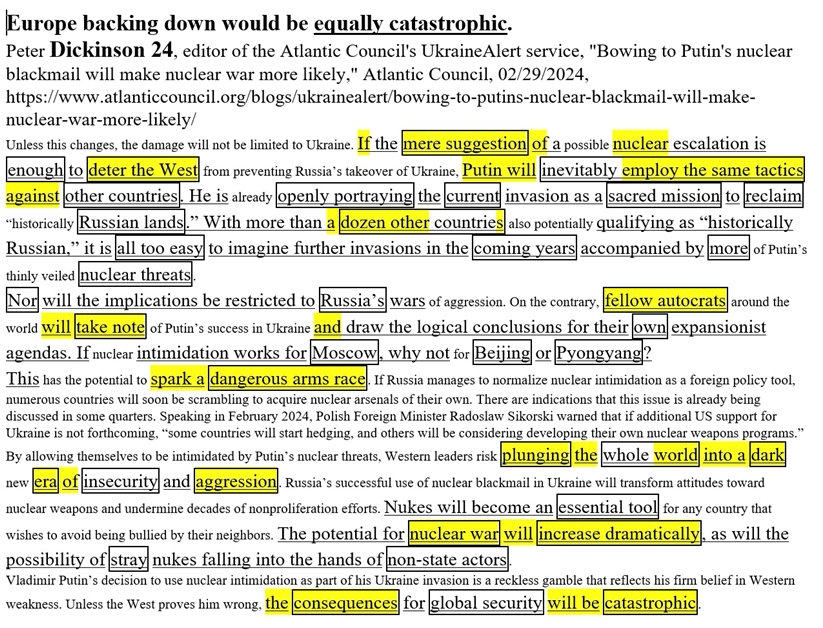
These forms of development achieve many of the benefits of adding new impacts while simultaneously complicating basic impact defense execution for the neg.
- Distribute across speeches. You might say reading a lot of impacts is good because it means the negative will have a difficult time accessing an external impact. I would counter by saying you can read case accesses DA in the 2AC instead, and that is better.
For the negative:
- Plan for volume. It is most probable that the affirmative is going to read a lot of terminal impacts. The main purpose is to give you opportunities to mess something up, not defeat something specific in the negative arsenal.
- Non-defense options. The first question you have to always answer is “what’s the offense?” The second question you have to answer is how you are going to reconcile the case. The options are:
- Counterplan
- Combination of “status quo sustainable” (uniqueness arguments), “internal link small/things are resilient”, “impact magnitude is small”
- Impact turn that swallows up and turns the other impacts
- DA turns every part of the case (but you would still need uniqueness). If you do this entirely on the case pages, old heads would call this link turning.
Most people are taught you have to read impact defense to everything. My thoughts about impact defense are here:
 Lincoln Garrett
And Truf has a post on alternatives to impact defense here:
 Anthony Trufanov
It is true if you do not read defense about everything the one you skip will likely be what they go for, BUT that doesn’t mean impact defense is a better argument or more important than other case responses. When I am saying impact defense, I am referring to arguments about magnitude and timeframe. If you are making an argument akin to “the prediction you made is unlikely” that is contesting some part of the chain above the impact.
The impact defense game, against enterprising 2As, is ultimately a cat and mouse game. For one, debating impacts in a vacuum while ceding truth claims about the uniqueness and internal link will likely let the affirmative distinguish away your defense more easily than you would like.
For another, the best 2As are amoral. They do not give a shit what they beat you with. They speak last, they only need one impact and the negative will be expected to read more evidence than the affirmative to win an issue (1 aff card vs 1 neg card leans affirmative, 1 aff card vs 2 neg cards leans negative etc). These elements allow the affirmative to maintain the initiative throughout the whole debate when the negative only responds with “your impacts are not as big as you think.”
The way to retake the initiative is...
- Attack the bottlenecks.
Stop scouting based off solely the plan text and the terminal impacts. Start figuring out where the impacts come from.
DA interaction with internal links is more helpful than the terminal impacts (particularly when some of these arguments boil down to war causes warming etc. In this world you already won a big war is going to happen!).
Adv CP’s are ripe for innovation. They do not need to be 12 planks targeting every impact. I would call these different types of CP’s conceptual alternatives to what the affirmative is going on about. Should we have an executive branch with unions or something different like citizen juries? Should we run everything like libertarians say? Should the US be more like China (China has one giant union, but they cannot strike and they don’t really have CBR)? Is the only way to deal with automation to bargain over it? Obviously not. Get creative.
If one were to summarize where all the impacts are coming from, it would look like:
- Good information for AI models
- Pro-social AI instead of Scrooge McDuck AI
- Deploying AI too fast is bad
- Wage stagnation
- Unions are good for democracy
- Doctor burnout
- Smart people in government good, corrupt cronies are bad.
- Deregulation is bad
- Whistleblowers are good
That is not an exclusive list but that is where like 85% to 90% of the impacts come from. The list of terminal impacts stemming from the above is way longer.
Remember, negative teams: the dream is for the affirmative to break a new aff and get absolutely smoked. That needs to be the "why" behind your grind. Carry these insights forward with you as you prepare for the biggest debates of the season.